The 2009 Amgen Tour of California, the largest cycling event in America, will stream the race live on the Web using the Adobe Flash Platform. A Tour de France-style cycling event presented by AEG from February 14-22, 2009, the race challenges the world’s top professional cycling teams and the most talented riders— including seven-time Tour de France champion Lance Armstrong (whom I had the honor of meeting)—to compete along a demanding 750-mile course from Sacramento to Escondido, Calif. This marks the third consecutive year that AEG selected the Adobe Flash Platform to bring the race to cycling fans worldwide in streaming video, with real-time rider tracking and live commentary.
The architecture employs a variation of the three tier model - a rich client side, the middle aggregation tier, and the resources which includes live logging of the cyclists positions from GPS. The Tour Tracker was developed using Adobe Flex® Builder™ and Adobe® LiveCycle®, and is meant to be an immersive Web application that incorporates live video, audio, and real-time data streams of the event. So much for regular TV!
When the race starts, you can follow it with the Live Tour Tracker. Cycling fans can track the race minute-by-minute through the innovative and highly interactive online Tour Tracker built on the Adobe Flash Platform. Delivered in the browser with Adobe Flash Player or via a downloadable application powered by Adobe® AIR®, the Tour Tracker ensures not a moment of the race will be missed.
Here are two challenges I want to pose. First - please give to the Lance Armstrong Foundation to fight cancer. This is a nasty disease and has touched so many lives. Lance started this foundation and when he is giving his all on the course, let's give him something back.
Second - I have started a petition to the Tour de France organizers to adopt this technology and broadcast via the web. I want to watch this at work. Please sign this important petition
http://www.thepetitionsite.com/2/tour-de-france-to-broadcast-on-the-web
Friday, February 13, 2009


Wednesday, February 11, 2009
Music 2.0 comes to Twitter
MixMatchMusic (www.mixmatchmusic.com) launched tra.kz, an easy-to-use linking technology that helps musicians virally promote their music and engage fans using Twitter. Controlled Substance Sound Labs label artists including Slightly Stoopid, Pepper, The Expendables, Mat McHugh and The Blackbird, Fishbone, and Rebelution are among some the first bands to promote their music via Twitter campaigns powered by tra.kz.
tra.kz is the first address link and URL shortener specifically for music and music-related content on the micro-web, including MP3s, music videos, artist interviews, news and reviews. Artists, and also fans sending tweets about music, use tra.kz to point to the MP3 files and other music-related content on artist sites, MySpace pages or elsewhere. Without tra.kz, the URL links are often too long to include in tweets and by being given the visual cue of http://tra.kz/, music lovers will know that the link will take them to music related content.
This is a Flash-based solution for artists seeking to make collaborative music and allow people to remix. Twitter provides the updates so if you want to get the latest music in real time, this is the next best thing to being in the actual studio listening to a producer try different mixes of your favorite bands.
What is also cool is that this is linked to a revenue model whereby artists set their parameters and share in revenue from listens, music for movies deals and sales of their content. I also think it is cool because this fights fire with fire. Supply and demand has typically been one artist track being demanded by lots of individuals. Now artists can provide multiple end mixes for one track, this reversing the deprecated economic models of the old music industry.
From MixMatchMusic:
Controlled Substance Sound Labs (http://www.myspace.com/controlledsubstancesoundlabs ) label umbrella for Stoopid Records and Law Records are using tra.kz to engage fans and promote music by releasing new music from artists Pepper, Slightly Stoopid, The Expendables, Fishbone, Rebelution, Mat McHugh and the Blackbird, Sabotage Soundsystem, and Giant Panda Guerilla Dub Squad.
MicMatchMusic CEO Feinn said additional independent artists including BLVD, Angel Pier, Enzyme Dynamite, Trifonic, Throw Me the Statue, Dreamlin featuring Kim Powers, The Dance Party, T. Mandrake, and Radio Nowhere, are also using tra.kz to promote their new releases.
He said that MixMatchMusic will be supporting these artists' Twitter and tra.kz campaigns by releasing a song on Twitter each hour throughout Wednesday, February 11, accompanied by information about the song and artist on Evolving Music (http://evolvingmusic.wordpress.com ).
MixMatchMusic provides emerging artists with a number of technical, social and musical assets with which they can collaborate on, profit from and engage fans with their music:
• A dynamic music community. MixMatchArtists contribute parts of songs, called stems, such as guitar riffs, drum and vocal tracks; works in progress; or finished songs. Community members can search thru this catalog of sounds and songs to find stems to complement their own song ideas and works in progress. They can also communicate with other musicians to discuss song or album projects. Casual fans – even those who don't play an instrument – can experiment with the sounds, discover new music and download stems or songs for use as ringtones or soundtracks for slide shows.
• The MixMaker audio sequencer. Members of the community use the sequencer to mix, match, mash up and manipulate their stems along with stems contributed by various artists. The sequencer combines and synchronizes stems and tracks; its edit tools are powerful and precise, but easy-to-use.
• The MixMatchMusic marketplace. The marketplace is an enlightened system of rights tuned to the unique requirements of digital music and the needs of digital musicians. The marketplace also includes highly transparent accounting processes and transaction logs that ensure musicians know the status of their work, are attributed and paid whenever it is downloaded or used in other art, or even by casual fans as ringtones. Musicians collect 85 cents on each dollar transacted.
• The Remix Wizard is a widget installed on artist sites or MySpace pages that provides fans direct access to a simplified, lightweight version of the sequencer. Artists load stems of their songs into the Remix Wizard and invite their fans to mix and match the various parts and create entirely new compositions from those parts. The Remix Wizard is a simple-to-install and easy-to-use widget that gives indie artists a cool viral tool for engaging fans, and allows them to emulate the hugely popular remix promotions mounted by bands such as Radiohead and Nine Inch Nails.
I am going to set up my bands on this as soon as I am back from Whistler.
Disclaimer: I have a personal financial interest in MixMatchMusic. I just want to disclose that so readers can fairly judge the preceding test.
tra.kz is the first address link and URL shortener specifically for music and music-related content on the micro-web, including MP3s, music videos, artist interviews, news and reviews. Artists, and also fans sending tweets about music, use tra.kz to point to the MP3 files and other music-related content on artist sites, MySpace pages or elsewhere. Without tra.kz, the URL links are often too long to include in tweets and by being given the visual cue of http://tra.kz/, music lovers will know that the link will take them to music related content.
This is a Flash-based solution for artists seeking to make collaborative music and allow people to remix. Twitter provides the updates so if you want to get the latest music in real time, this is the next best thing to being in the actual studio listening to a producer try different mixes of your favorite bands.
What is also cool is that this is linked to a revenue model whereby artists set their parameters and share in revenue from listens, music for movies deals and sales of their content. I also think it is cool because this fights fire with fire. Supply and demand has typically been one artist track being demanded by lots of individuals. Now artists can provide multiple end mixes for one track, this reversing the deprecated economic models of the old music industry.
From MixMatchMusic:
"tra.kz is also a highly viral way for music fans and members of the Twitter community to share music and music-related content among themselves. We think it is going to spark a ton of music discovery, and that's good for artists and fans alike."Fans browsing Twitter feeds will be able to quickly spot out music related content and play music files directly through tra.kz's player. "tra.kz is the no fuss, no muss shortcut for discovering music, and all the great content that surrounds it, directly from a tweet.
Controlled Substance Sound Labs (http://www.myspace.com/
MicMatchMusic CEO Feinn said additional independent artists including BLVD, Angel Pier, Enzyme Dynamite, Trifonic, Throw Me the Statue, Dreamlin featuring Kim Powers, The Dance Party, T. Mandrake, and Radio Nowhere, are also using tra.kz to promote their new releases.
He said that MixMatchMusic will be supporting these artists' Twitter and tra.kz campaigns by releasing a song on Twitter each hour throughout Wednesday, February 11, accompanied by information about the song and artist on Evolving Music (http://evolvingmusic.
MixMatchMusic provides emerging artists with a number of technical, social and musical assets with which they can collaborate on, profit from and engage fans with their music:
• A dynamic music community. MixMatchArtists contribute parts of songs, called stems, such as guitar riffs, drum and vocal tracks; works in progress; or finished songs. Community members can search thru this catalog of sounds and songs to find stems to complement their own song ideas and works in progress. They can also communicate with other musicians to discuss song or album projects. Casual fans – even those who don't play an instrument – can experiment with the sounds, discover new music and download stems or songs for use as ringtones or soundtracks for slide shows.
• The MixMaker audio sequencer. Members of the community use the sequencer to mix, match, mash up and manipulate their stems along with stems contributed by various artists. The sequencer combines and synchronizes stems and tracks; its edit tools are powerful and precise, but easy-to-use.
• The MixMatchMusic marketplace. The marketplace is an enlightened system of rights tuned to the unique requirements of digital music and the needs of digital musicians. The marketplace also includes highly transparent accounting processes and transaction logs that ensure musicians know the status of their work, are attributed and paid whenever it is downloaded or used in other art, or even by casual fans as ringtones. Musicians collect 85 cents on each dollar transacted.
• The Remix Wizard is a widget installed on artist sites or MySpace pages that provides fans direct access to a simplified, lightweight version of the sequencer. Artists load stems of their songs into the Remix Wizard and invite their fans to mix and match the various parts and create entirely new compositions from those parts. The Remix Wizard is a simple-to-install and easy-to-use widget that gives indie artists a cool viral tool for engaging fans, and allows them to emulate the hugely popular remix promotions mounted by bands such as Radiohead and Nine Inch Nails.
I am going to set up my bands on this as soon as I am back from Whistler.
Disclaimer: I have a personal financial interest in MixMatchMusic. I just want to disclose that so readers can fairly judge the preceding test.
Tom's cool Zend AMF PHP extensions!
Normally when I am on vacation, I will post rather work -unrelated posts on this blog. Yesterday's downhill ski run was a good example. Today however, my Adobe compatriot did something so cool I felt compelled to blog about it. Here is the message he sent:
*****************
UPDATE: When I originally posted this, I had credited Tom. It is actually Piotr's creation - Tom was just kind enough to forward this to me. Both these guys are excellent programmers - check out their blogs!
*****************
"Just for your info guys, I published today my ZendAmfDs extension to Zend_Amf... - this is just to let you know if any one is interested in PHP stuff. ZendAmfDs allows you to configure SELECT and INSERT statements on server side (in xml file) and execute these from Flex in a nice and clean way ;) This release doesn’t support UPDATE’s yet but planning to have it implemented or maybe/hopefully someone from the community will pick this up. More info you will find here: http://www.riaspace.net/2009/02/zendamfds-first-release/
Another thing that is very interesting is that I’m receiving very positive feedback after one of my previous blog posts where I described how to configure Zend_Amf with whole Zend Framework and how to use it all together... It turns out people are actually looking into taking whole Zend Framework not only Zend_Amf."
IMO - this is very cool! Go check it out.
*****************
UPDATE: When I originally posted this, I had credited Tom. It is actually Piotr's creation - Tom was just kind enough to forward this to me. Both these guys are excellent programmers - check out their blogs!
*****************
"Just for your info guys, I published today my ZendAmfDs extension to Zend_Amf... - this is just to let you know if any one is interested in PHP stuff. ZendAmfDs allows you to configure SELECT and INSERT statements on server side (in xml file) and execute these from Flex in a nice and clean way ;) This release doesn’t support UPDATE’s yet but planning to have it implemented or maybe/hopefully someone from the community will pick this up. More info you will find here: http://www.riaspace.net/2009/02/zendamfds-first-release/
Another thing that is very interesting is that I’m receiving very positive feedback after one of my previous blog posts where I described how to configure Zend_Amf with whole Zend Framework and how to use it all together... It turns out people are actually looking into taking whole Zend Framework not only Zend_Amf."
IMO - this is very cool! Go check it out.
Tuesday, February 10, 2009
Saturday, February 07, 2009
Are Hotel room numbering conventions depracated?

I found this in the hallway as I was trying to find room 432 (the one I was staying in). I was not really sure what to make of it. I eventually found it and did not have to sleep in a semi-colon.
Whoever made this sign should have given it a bit more thought IMO. Either that or they laugh out loud knowing every day room 432 gets re-assigned to some helpless chap like myself.
Friday, February 06, 2009
I am starting to really, really love ColdFusion (again)
I was an Allaire CF user back in 1999 or thereabouts when it was first available. In fact, I remember Blue Mountain offering it using the "brand new" ASP model. The fact I could integrate data into dynamic HTML was really cool.
If you have been like me, a bit short of CF activity for a long time, it is time to look at CF again. CF rocks!! It is so easy to use and takes minutes to integrate with most technologies. Now I am not a professional programmer who uses it every day, but that is what stands out. Declarative programming languages are just easy to use. CF is the master.
On another note, someone once pointed out that CF developers are paranoid sometimes. I can see why. If you saw your favorite technology being bought and acquired a few times, you might be unsure what direction it may take. I really hope Adobe has been clear but CF developers have a strong evangelist in me and I am an Adobe employee. If I can be of any help to clarify the future of CF or you need an ally, call me. I'll go as far as it takes to ensure CF lives forever!!
I also thought I'd make fun of CF developers (making fun of ourselves used to be part of the CF culture back in the Allaire days) and my boss, Ben Forta, seems to embody this. I wrote an algorithm for how CF developers' internal thinking process works. It is just a joke so please do not take offense.
* yes - I consider myself a CF person now!
*************************************
Import com.array.ColdFusionHaterList.*;
Private var developer = new Developer;
// create a new conversation and pass it the argument of the instance of developer.
Private var myConversation conv = new conversation(developer).startConversation();
// test to see if Coldfusion is mentioned once every twelve words.
if ((conv.getWordCountSpoken() >= 12) && (String(“ColdFusion”) = “false”))
{
coldFusionHaterList.add(developer);
} else {
conv.keepListening();
}
//LOL
I am now offline for the week to go to Whistler and read a CF book to learn more advanced topics. Cheers!
If you have been like me, a bit short of CF activity for a long time, it is time to look at CF again. CF rocks!! It is so easy to use and takes minutes to integrate with most technologies. Now I am not a professional programmer who uses it every day, but that is what stands out. Declarative programming languages are just easy to use. CF is the master.
On another note, someone once pointed out that CF developers are paranoid sometimes. I can see why. If you saw your favorite technology being bought and acquired a few times, you might be unsure what direction it may take. I really hope Adobe has been clear but CF developers have a strong evangelist in me and I am an Adobe employee. If I can be of any help to clarify the future of CF or you need an ally, call me. I'll go as far as it takes to ensure CF lives forever!!
I also thought I'd make fun of CF developers (making fun of ourselves used to be part of the CF culture back in the Allaire days) and my boss, Ben Forta, seems to embody this. I wrote an algorithm for how CF developers' internal thinking process works. It is just a joke so please do not take offense.
* yes - I consider myself a CF person now!
*************************************
Import com.array.ColdFusionHaterList.*;
Private var developer = new Developer;
// create a new conversation and pass it the argument of the instance of developer.
Private var myConversation conv = new conversation(developer).startConversation();
// test to see if Coldfusion is mentioned once every twelve words.
if ((conv.getWordCountSpoken() >= 12) && (String(“ColdFusion”) = “false”))
{
coldFusionHaterList.add(developer);
} else {
conv.keepListening();
}
//LOL
I am now offline for the week to go to Whistler and read a CF book to learn more advanced topics. Cheers!
Thursday, February 05, 2009
Adobe AIR covered in Time Magazine
I got an internal email from a colleague today about this article in Time Magazine (note it is on page 2 of the article):
Very cool that Time has recognized the immense value and shift!
"A nice piece in Time Magazine (online today, in hard copy next issue) discusses new applications and products for e-reading, and the future of publishing. The writer references the concept of an “appgazine” — magazines acting “more like computer programs than Web or printed pages.” He interviewed Kevin L who demonstrated the International Herald Tribune Reader and (RED)WIRE applications.
"I saw my first real appgazine one day in downtown San Francisco, at Adobe, a company whose software dominates the production side of the publishing industry. Chief technology officer Kevin Lynch held in his hands a mobile Internet device made by a Chinese company called Aigo. This model, already on the market in Asia, has an easily readable touchscreen. But more interesting than how it looked was the software it was running — Adobe AIR."
Very cool that Time has recognized the immense value and shift!
Tuesday, February 03, 2009
Music 2.0: Why don't you pay for music? Read this!
Apparently independent music platform Indaba was on the Colbert Report this week. It can be viewed here. Stephen chats with Dan Zaccagnino, head of an online community of musicians known as Indaba Music. In his (NOTE: Update - these are Stephen's words, not Dan's from Indaba) own words - you should be able to legally remix anybody else's tracks on the Internet. Several sites such as MixMatchMusic.com are doing this today.
Does anyone think this is a good idea or should it be up to the artist? As a musician, I prefer to retain control over certain uses of my works (such as via Creative Commons licensing). Not that people in bulk are respecting licenses today, but in a perfect world.
Here is my argument. To get to where I am today, I took 8 years of piano lessons (cost: unknown), currently own about $25,000 worth of music equipment, have paid out well over $100,00 in my lifetime for various music related activities, pay out $135 per month towards rehearsal space, and my time goes on top of that. My band, 22nd Century's CD "The Twenty Second Century" cost about $17,000 for the first 1,000 CDs. To date, we have had no sales (primarily because we have not yet set up online sales) however we are now using CD Baby. Yes - as of this week, you can buy and even listen to my latest music at http://cdbaby.com/cd/22ndcentury. This works out to an artist cost of about $2.80 per track. Even if we sell this via iTunes and net $0.60 per track, we will have to sell close to 100,000 copies to break even on the recording costs (the scale slides the more CDs you make). As a musician, this sort of despair and helplessness is our everyday life. This really sucks people!!!!
Some of my music is free though. I do this to be a good musician and offer my stuff that I am not planning to record (and put on CD or iTunes) on MixMatchMusic.com or Mixr.com (subsidiary). I do this in hopes people might use it for something, so I am torn.
So here is the 22nd Century $1,000,000 question - who will be the first person to actually pay for a copy of our CD? What can I do as an artist to convince you, the listener, that my multi $100,000 investment into music is worth $0.99 a track for my songs? For those of you who do not like our songs, we're cool with that. Our style reflects who we are, not commercial interests. Obviously if it did, you would have to conclude we were dumb to enter into the music business as entrepreneurs.
What business model can work or MixMatchMusic? Would you pay a fee to download fresh "members only" mixes every day? Would you pay a small fee to buy CDs or get free trials of every new mix pushed to your desktop? Would you be willing to accept advertising on the site? The reason I ask is that sites such as CD Baby, Indaba, and MixMatchMusic cannot survive without business models that drive strong sales and if they dry up, your music choices dry up.
As a civilization, we have to support the arts or pay for fair use when the artist demands it. In return, artists may grant us more leverage to remix some of their content. For now, nobody is making money.
Think about this one hard please.
(Disclosures - I may have commercial interest in MixMatchMusic)
Does anyone think this is a good idea or should it be up to the artist? As a musician, I prefer to retain control over certain uses of my works (such as via Creative Commons licensing). Not that people in bulk are respecting licenses today, but in a perfect world.
Here is my argument. To get to where I am today, I took 8 years of piano lessons (cost: unknown), currently own about $25,000 worth of music equipment, have paid out well over $100,00 in my lifetime for various music related activities, pay out $135 per month towards rehearsal space, and my time goes on top of that. My band, 22nd Century's CD "The Twenty Second Century" cost about $17,000 for the first 1,000 CDs. To date, we have had no sales (primarily because we have not yet set up online sales) however we are now using CD Baby. Yes - as of this week, you can buy and even listen to my latest music at http://cdbaby.com/cd/22ndcentury. This works out to an artist cost of about $2.80 per track. Even if we sell this via iTunes and net $0.60 per track, we will have to sell close to 100,000 copies to break even on the recording costs (the scale slides the more CDs you make). As a musician, this sort of despair and helplessness is our everyday life. This really sucks people!!!!
Some of my music is free though. I do this to be a good musician and offer my stuff that I am not planning to record (and put on CD or iTunes) on MixMatchMusic.com or Mixr.com (subsidiary). I do this in hopes people might use it for something, so I am torn.
So here is the 22nd Century $1,000,000 question - who will be the first person to actually pay for a copy of our CD? What can I do as an artist to convince you, the listener, that my multi $100,000 investment into music is worth $0.99 a track for my songs? For those of you who do not like our songs, we're cool with that. Our style reflects who we are, not commercial interests. Obviously if it did, you would have to conclude we were dumb to enter into the music business as entrepreneurs.
What business model can work or MixMatchMusic? Would you pay a fee to download fresh "members only" mixes every day? Would you pay a small fee to buy CDs or get free trials of every new mix pushed to your desktop? Would you be willing to accept advertising on the site? The reason I ask is that sites such as CD Baby, Indaba, and MixMatchMusic cannot survive without business models that drive strong sales and if they dry up, your music choices dry up.
As a civilization, we have to support the arts or pay for fair use when the artist demands it. In return, artists may grant us more leverage to remix some of their content. For now, nobody is making money.
Think about this one hard please.
(Disclosures - I may have commercial interest in MixMatchMusic)
Duane's World 16 - jFall Java user Group, Netherlands!
It is now live. This episode covers probably the largest user group meeting I have ever attended. There is also a great section on LC ES Workbench and how the Eclipse IDE reflects the Java API Docs. There are several interviews.
Monday, February 02, 2009
iPod Touch update killed my iPod!
I tried to update to the new firmware version (recommended) by Apple today. The log file says:
Feb 2 00:00:00 duane-nickulls-mac-pro newsyslog[1427]: logfile turned over
Feb 2 08:54:57 duane-nickulls-mac-pro [0x0-0x27027].com.apple.iTunes[620]: Child: Can't read length for data
Feb 2 08:54:57 duane-nickulls-mac-pro [0x0-0x27027].com.apple.iTunes[620]: Child: NULL command dict read, exiting...
Feb 2 08:54:58 duane-nickulls-mac-pro [0x0-0x27027].com.apple.iTunes[620]: Could not receive size of message
Feb 2 08:54:58 duane-nickulls-mac-pro [0x0-0x27027].com.apple.iTunes[620]: MobileDevice: receive_message: Could not receive size of message: 0 Unknown error: 0
Feb 2 08:54:58 duane-nickulls-mac-pro [0x0-0x27027].com.apple.iTunes[620]: MobileDevice: _read_callback: Could not receive message
Feb 2 08:55:26 duane-nickulls-mac-pro [0x0-0xc00c].com.apple.systemuiserver[131]: DigiHub:sendChargingCommandToDevice RequestExtraPower(kUSBPowerDuringWake) returned 0
Feb 2 08:55:26 duane-nickulls-mac-pro [0x0-0xc00c].com.apple.systemuiserver[131]: DigiHub:sendChargingCommandToDevice sending command with sleep: 0, wake 0
Feb 2 08:55:26 duane-nickulls-mac-pro [0x0-0x27027].com.apple.iTunes[620]: MobileDevice: AMDeviceConnect: This is not the droid you're looking for. Move along, move along.
Feb 2 08:55:26 duane-nickulls-mac-pro [0x0-0x10010].com.apple.iTunesHelper[148]: MobileDevice: AMDeviceConnect: This is not the droid you're looking for. Move along, move along.
Feb 2 08:59:32 duane-nickulls-mac-pro dashboardadvisoryd[2211]: fetch: unable to fetch data from read stream while fetch advisory list
Feb 2 09:01:33 duane-nickulls-mac-pro kernel[0]: iTunes[620] uses send/recv on a pipe
Feb 2 09:01:32 duane-nickulls-mac-pro [0x0-0x27027].com.apple.iTunes[620]: MobileDevice: send_message: Could not send message size: Bad file descriptor
Feb 2 09:01:32 duane-nickulls-mac-pro [0x0-0x27027].com.apple.iTunes[620]: Parent: Error or timeout on select
Feb 2 09:01:32 duane-nickulls-mac-pro [0x0-0x27027].com.apple.iTunes[620]: Parent: NULL message read
Feb 2 09:01:32 duane-nickulls-mac-pro [0x0-0x27027].com.apple.iTunes[620]: Crash report copy task disappeared while submitting a restore log
Feb 2 09:02:33 duane-nickulls-mac-pro MDCrashReportTool[2229]: CFReadStreamGetError() returned: 12/8
Feb 2 09:02:33 duane-nickulls-mac-pro /System/Library/PrivateFrameworks/MobileDevice.framework/Versions/Current/AppleMobileDeviceHelper.app/Contents/Resources/MDCrashReportTool[2229]: 2229:2693486368|CrashReportCopyX.m:-[CrashReportCopierPrivate _submitCrashReportFromPath:]| ERROR: Error 2 while attempting to submit /Users/dnickull/Library/Logs/iPod Updater Logs/iPodUpdater 1.log.plist
Feb 2 09:02:33 duane-nickulls-mac-pro [0x0-0x27027].com.apple.iTunes[620]: Child: Can't write length for data
Feb 2 09:02:33 duane-nickulls-mac-pro [0x0-0x27027].com.apple.iTunes[620]: Child: Couldn't write response, exiting...
Feb 2 09:02:33 duane-nickulls-mac-pro [0x0-0x27027].com.apple.iTunes[620]: Child: Can't write length for data
Unfortunately, now my iPod Touch (2G) does not work. It is not recognized nor is it responsive to any input. All it displays is an apple and some weird oval diagram.
Anyone have similar experiences? I have seen one other result but cannot find it.
Duane
Feb 2 00:00:00 duane-nickulls-mac-pro newsyslog[1427]: logfile turned over
Feb 2 08:54:57 duane-nickulls-mac-pro [0x0-0x27027].com.apple.iTunes[620]: Child: Can't read length for data
Feb 2 08:54:57 duane-nickulls-mac-pro [0x0-0x27027].com.apple.iTunes[620]: Child: NULL command dict read, exiting...
Feb 2 08:54:58 duane-nickulls-mac-pro [0x0-0x27027].com.apple.iTunes[620]: Could not receive size of message
Feb 2 08:54:58 duane-nickulls-mac-pro [0x0-0x27027].com.apple.iTunes[620]: MobileDevice: receive_message: Could not receive size of message: 0 Unknown error: 0
Feb 2 08:54:58 duane-nickulls-mac-pro [0x0-0x27027].com.apple.iTunes[620]: MobileDevice: _read_callback: Could not receive message
Feb 2 08:55:26 duane-nickulls-mac-pro [0x0-0xc00c].com.apple.systemuiserver[131]: DigiHub:sendChargingCommandToDevice RequestExtraPower(kUSBPowerDuringWake) returned 0
Feb 2 08:55:26 duane-nickulls-mac-pro [0x0-0xc00c].com.apple.systemuiserver[131]: DigiHub:sendChargingCommandToDevice sending command with sleep: 0, wake 0
Feb 2 08:55:26 duane-nickulls-mac-pro [0x0-0x27027].com.apple.iTunes[620]: MobileDevice: AMDeviceConnect: This is not the droid you're looking for. Move along, move along.
Feb 2 08:55:26 duane-nickulls-mac-pro [0x0-0x10010].com.apple.iTunesHelper[148]: MobileDevice: AMDeviceConnect: This is not the droid you're looking for. Move along, move along.
Feb 2 08:59:32 duane-nickulls-mac-pro dashboardadvisoryd[2211]: fetch: unable to fetch data from read stream while fetch advisory list
Feb 2 09:01:33 duane-nickulls-mac-pro kernel[0]: iTunes[620] uses send/recv on a pipe
Feb 2 09:01:32 duane-nickulls-mac-pro [0x0-0x27027].com.apple.iTunes[620]: MobileDevice: send_message: Could not send message size: Bad file descriptor
Feb 2 09:01:32 duane-nickulls-mac-pro [0x0-0x27027].com.apple.iTunes[620]: Parent: Error or timeout on select
Feb 2 09:01:32 duane-nickulls-mac-pro [0x0-0x27027].com.apple.iTunes[620]: Parent: NULL message read
Feb 2 09:01:32 duane-nickulls-mac-pro [0x0-0x27027].com.apple.iTunes[620]: Crash report copy task disappeared while submitting a restore log
Feb 2 09:02:33 duane-nickulls-mac-pro MDCrashReportTool[2229]: CFReadStreamGetError() returned: 12/8
Feb 2 09:02:33 duane-nickulls-mac-pro /System/Library/PrivateFrameworks/MobileDevice.framework/Versions/Current/AppleMobileDeviceHelper.app/Contents/Resources/MDCrashReportTool[2229]: 2229:2693486368|CrashReportCopyX.m:-[CrashReportCopierPrivate _submitCrashReportFromPath:]| ERROR: Error 2 while attempting to submit /Users/dnickull/Library/Logs/iPod Updater Logs/iPodUpdater 1.log.plist
Feb 2 09:02:33 duane-nickulls-mac-pro [0x0-0x27027].com.apple.iTunes[620]: Child: Can't write length for data
Feb 2 09:02:33 duane-nickulls-mac-pro [0x0-0x27027].com.apple.iTunes[620]: Child: Couldn't write response, exiting...
Feb 2 09:02:33 duane-nickulls-mac-pro [0x0-0x27027].com.apple.iTunes[620]: Child: Can't write length for data
Unfortunately, now my iPod Touch (2G) does not work. It is not recognized nor is it responsive to any input. All it displays is an apple and some weird oval diagram.
Anyone have similar experiences? I have seen one other result but cannot find it.
Duane
The Case against Flex.
I saw an article written today trying to make the case against using Flex. The author seems to have mixed up coding and architecture practices with the actual Flex framework. While the article's headline seems to be promoting a campaign against Flex, I think there are some good points to note WRT coding and architectural practices. I wish to share the comment I left on the site. The original article is here.
http://www.cmswatch.com/Trends/1492-The-case-against-Flex-based-application-Uis
In addition, I could have pointed out that Flex/Flash has strong accessibility on top of the points I made (Thanks to Ted Patrick for pointing this out to me).
************REPLY************
Tim:
Okay - glove thrown, challenge accepted. I will disagree. First I will voluntarily disclose to everyone that I am an Adobe employee. As a Technical Evangelist for Adobe, my job is often to work with large enterprise customers. While your arguments have some merit (bad coding styles can lead to nightmares in all programming and scripting languages), the Flex framework, combined with good coding discipline should be welcomed and not feared.
Specifically:
YOU: "They almost always violate web accessibility guidelines. Sure, many thin-client application interfaces are not compliant either, but at least you have the opportunity to make them compliant -- and many platforms (e.g., Plone) do so."
DN: This is an architectural decision that is in the hands of the developer. With Flex, as with any other technology, there are trade-offs. I could challenge you easily on your definition of "compliant" but will instead state that Flex has been developed in conjunction with what developers want. When you see large enterprises like SAP, Documentum and even our own LiveCycle Engineering team, moving to Flex, they have not made this decision lightly. They have fully evaluated and accepted the programming models of Flex as valid and have taken the time to lay out good architecture before coding. Can you provide specific examples of where the framework itself violates your definition of compliance rather than the coding or architectural styles? What specific "Web Accessibility Guidelines" are you referring to? Flex gives developers what they want and the power to choose their own paths.
YOU: "They create support nightmares. Things like automatic updates, license-checking, and incompatibilities with the underlying virtual machine lead to many a help-desk call. As my colleague Kas notes, with AIR instead of applets you are just replacing Sun's virtual machine with Adobe's. The potential for trouble remains."
DN: Why do you think automatic updates are "support nightmares"? They are used universally by most software vendors for convenience and ease of use. Same with automatic checking for incompatibilities. The Java platform uses the same mechanisms. I strongly challenge this statement.
YOU: "They are prone to performance problems. Flex applications are prone to the same memory leaks and CPU spikes that bedeviled applets for years. To be sure, I've seen some fat and ugly JavaScript-based interfaces too, but at least everyone can debug those openly. We've also had customers tell us that their Flex interfaces are unusually chatty on their networks."
DN: As with any technology, Flex's ease of use provides new developers an opportunity to get in over their heads. Poor coding practices notwithstanding, the Flex IDE (Flex Builder) has a Debugger, Profiler, the ability to set break points to see what is exactly happening with your code. At the risk of sounding antagonistic, I would invite you to take a few hours to do some actual coding or take a hands on course with Flex to see exactly what is possible with the IDE. CPU spikes and memory leaks are the bane of every language. If you know of any specific issues in the current Flex framework, please file a bug with via opensource.adobe.com. I am sure the millions of Flash and Flex Developers will vote for such a bug if you can prove a demonstrate able, repeatable issue.
YOU: "You can't easily modify them. The vendor sets a unified interface and all their customers have to live with it. That might work for a one-dimensional tool, like a Twitter client, but what about more heterogeneous, multidimensional environments?"
DN: Again, proper coding disciplines and styles will help anyone create a maintainable code base. We have multiple MVC frameworks developed (Cairngorm, Matte et al) and firmly believe this is a developer and architect choice to embrace the discipline as it is with any other language. I can create code in any programming or scripting language that is obfuscated and hard to maintain. By contrast, I can also separate concerns and keep related classes properly documented and laid out with a well defined architectural style to avoid maintenance nightmares.
To sum my arguments up, I firmly believe your arguments are valid against bad coding and bad architectural practices. My advice is that anyone building enterprise applications in Flex or even just starting out, take the time to properly document, plan and architect their applications.
Duane Nickull
http://www.cmswatch.com/Trends/1492-The-case-against-Flex-based-application-Uis
In addition, I could have pointed out that Flex/Flash has strong accessibility on top of the points I made (Thanks to Ted Patrick for pointing this out to me).
************REPLY************
Tim:
Okay - glove thrown, challenge accepted. I will disagree. First I will voluntarily disclose to everyone that I am an Adobe employee. As a Technical Evangelist for Adobe, my job is often to work with large enterprise customers. While your arguments have some merit (bad coding styles can lead to nightmares in all programming and scripting languages), the Flex framework, combined with good coding discipline should be welcomed and not feared.
Specifically:
YOU: "They almost always violate web accessibility guidelines. Sure, many thin-client application interfaces are not compliant either, but at least you have the opportunity to make them compliant -- and many platforms (e.g., Plone) do so."
DN: This is an architectural decision that is in the hands of the developer. With Flex, as with any other technology, there are trade-offs. I could challenge you easily on your definition of "compliant" but will instead state that Flex has been developed in conjunction with what developers want. When you see large enterprises like SAP, Documentum and even our own LiveCycle Engineering team, moving to Flex, they have not made this decision lightly. They have fully evaluated and accepted the programming models of Flex as valid and have taken the time to lay out good architecture before coding. Can you provide specific examples of where the framework itself violates your definition of compliance rather than the coding or architectural styles? What specific "Web Accessibility Guidelines" are you referring to? Flex gives developers what they want and the power to choose their own paths.
YOU: "They create support nightmares. Things like automatic updates, license-checking, and incompatibilities with the underlying virtual machine lead to many a help-desk call. As my colleague Kas notes, with AIR instead of applets you are just replacing Sun's virtual machine with Adobe's. The potential for trouble remains."
DN: Why do you think automatic updates are "support nightmares"? They are used universally by most software vendors for convenience and ease of use. Same with automatic checking for incompatibilities. The Java platform uses the same mechanisms. I strongly challenge this statement.
YOU: "They are prone to performance problems. Flex applications are prone to the same memory leaks and CPU spikes that bedeviled applets for years. To be sure, I've seen some fat and ugly JavaScript-based interfaces too, but at least everyone can debug those openly. We've also had customers tell us that their Flex interfaces are unusually chatty on their networks."
DN: As with any technology, Flex's ease of use provides new developers an opportunity to get in over their heads. Poor coding practices notwithstanding, the Flex IDE (Flex Builder) has a Debugger, Profiler, the ability to set break points to see what is exactly happening with your code. At the risk of sounding antagonistic, I would invite you to take a few hours to do some actual coding or take a hands on course with Flex to see exactly what is possible with the IDE. CPU spikes and memory leaks are the bane of every language. If you know of any specific issues in the current Flex framework, please file a bug with via opensource.adobe.com. I am sure the millions of Flash and Flex Developers will vote for such a bug if you can prove a demonstrate able, repeatable issue.
YOU: "You can't easily modify them. The vendor sets a unified interface and all their customers have to live with it. That might work for a one-dimensional tool, like a Twitter client, but what about more heterogeneous, multidimensional environments?"
DN: Again, proper coding disciplines and styles will help anyone create a maintainable code base. We have multiple MVC frameworks developed (Cairngorm, Matte et al) and firmly believe this is a developer and architect choice to embrace the discipline as it is with any other language. I can create code in any programming or scripting language that is obfuscated and hard to maintain. By contrast, I can also separate concerns and keep related classes properly documented and laid out with a well defined architectural style to avoid maintenance nightmares.
To sum my arguments up, I firmly believe your arguments are valid against bad coding and bad architectural practices. My advice is that anyone building enterprise applications in Flex or even just starting out, take the time to properly document, plan and architect their applications.
Duane Nickull
Friday, January 30, 2009
Killer Japanese Robot Toilets?
Okay - this is probably going to be my most bizarre blog post ever. Since arriving in Tokyo, I have been completely bewildered by the toilets in the hotel and conference centre. They are connected to electricity and have all sorts of weird warning and caution labels all over them. Is it just me or does running electricity into a toilet seem like a bit of a dangerous idea? Mine has no less than 5 buttons and a complete array of instructions and cautions. Since they are all written in a combination of Katakana, Hirigana and Kanji, I have no idea what they mean. I was scared!

I have been very careful not to touch any of the buttons for fear of receiving ice cold water up the backside. Take a closer look at the controls. Does any of this look enjoyable?

Does the middle one imply that the water pressure can be so high it can literally lift you into the air by aiming pressurized water up the rear? The woman in the graphic looks like she is balanced on a fountain of toilet water. I was wondering if you hit the stop button you just free fall back to the seat all of a sudden or if it just gently lets you back down?
Building a robotic toilet just seems like a bad idea. ROTFL!! I love Japan!!!

I have been very careful not to touch any of the buttons for fear of receiving ice cold water up the backside. Take a closer look at the controls. Does any of this look enjoyable?

Does the middle one imply that the water pressure can be so high it can literally lift you into the air by aiming pressurized water up the rear? The woman in the graphic looks like she is balanced on a fountain of toilet water. I was wondering if you hit the stop button you just free fall back to the seat all of a sudden or if it just gently lets you back down?
Building a robotic toilet just seems like a bad idea. ROTFL!! I love Japan!!!
Wednesday, January 28, 2009
Kon'nichi-wa Tokyo!
Got to Japan. About to give a talk on Adobe SOA in the Enterprise (mainly focusing on LiveCycle, Flex, ColdFusion etc.) and then I'm doing the sneak peaks on server-side ActionScript. I love this country. We are in the Daiba district.

Wish I had brought my video camera for filming an episode of Duane's World.
Tomorrow I get to demo Ichabod, the headless Flash player that allows Google to index Flash content and follows links and states. I have it running on an Ubuntu instance on VMWare and have been running some of my own tests. I just figured out a new way to force Google to index Flash content (jump the queue). Anyone want to know?
;-)

Wish I had brought my video camera for filming an episode of Duane's World.
Tomorrow I get to demo Ichabod, the headless Flash player that allows Google to index Flash content and follows links and states. I have it running on an Ubuntu instance on VMWare and have been running some of my own tests. I just figured out a new way to force Google to index Flash content (jump the queue). Anyone want to know?
;-)
Tuesday, January 27, 2009
Fender Frankenstein and Adobe!!!
On Monday, January 26, I got to go to Fender to talk to their developers (mostly all musicians themselves). What can I say? This was by far my best ever day as an Adobe Evangelist. To top the whole thing off, I got to play one of Eddie Van Halen's EVH Frankenstein guitars.

All the guys at Fender rock. My job is to go out and listen/preach about technology and work with architects to see how things might fit together, but I rarely get to join both my passions and work with music. As a musician, I have played Fender instruments most of my life. In fact, the only non-Fenders I own (one Jackson and one Hamer Flying V) are now both lines of guitars owned by Fender. To be blunt – I love Fender. My own Fender Frankenstein is my pride and joy (body by Cremer Guitarworks from USA).
The Hamer is a rare flying V designed for Michael Schenker. There were a very limited run of them and I was lucky enough to buy one in about 1984 for $2500. To date, it is my favorite studio axe.
So what are some good ideas for Fender’s web presence? One idea I strongly believe in is to harness collective intelligence, so I want to pose the question to all the musicians that use my blog. What do you want to see for Fender as a web presence? What is your idea of a perfect user experience with Fender?
One idea I think would be cool is to provide a music mix wizard like the one from www.mixmatchmusic.com. This would allow any Fender owner to post their tracks and mBits © to the MixMatchMusic site and allow people to remix, add vocals etc. This would be cool.
But not as cool as the honor of getting to play a real American made Fender Pre bass live on Stage with my bands 22nd Century and Stress Factor 9.


All the guys at Fender rock. My job is to go out and listen/preach about technology and work with architects to see how things might fit together, but I rarely get to join both my passions and work with music. As a musician, I have played Fender instruments most of my life. In fact, the only non-Fenders I own (one Jackson and one Hamer Flying V) are now both lines of guitars owned by Fender. To be blunt – I love Fender. My own Fender Frankenstein is my pride and joy (body by Cremer Guitarworks from USA).
The Hamer is a rare flying V designed for Michael Schenker. There were a very limited run of them and I was lucky enough to buy one in about 1984 for $2500. To date, it is my favorite studio axe.
So what are some good ideas for Fender’s web presence? One idea I strongly believe in is to harness collective intelligence, so I want to pose the question to all the musicians that use my blog. What do you want to see for Fender as a web presence? What is your idea of a perfect user experience with Fender?
One idea I think would be cool is to provide a music mix wizard like the one from www.mixmatchmusic.com. This would allow any Fender owner to post their tracks and mBits © to the MixMatchMusic site and allow people to remix, add vocals etc. This would be cool.
But not as cool as the honor of getting to play a real American made Fender Pre bass live on Stage with my bands 22nd Century and Stress Factor 9.

Sunday, January 25, 2009
SOA Soup? Hardly.
I came across this ridiculous blog post complaining about SOA standards initiatives and implying that all of us who worked on standards (well over 1000 people) have failed. This article has been curiously categorized under "Men's Health," which leads me to believe the ill-informed author is doing nothing more than trying to make some ad revenue.
Since the author decided not to reveal his or her identity, allow comments, or factually state matters related to SOA and provide a complete story, I decided to comment on it here.
First - the article itself is obviously short of one effort - the Open Group's SOA Reference Architecture. This really means we have 4 standards and figuring out how to use them and how they fit together can be daunting to an outsider (I'll concede this point). Here is how they work.
The OASIS SOA Reference Model is an abstract model for services. As such, it is a set of guiding principles on what SOA is. It is not the definitive definition of SOA, it is simple a definition. Also - since it is abstract, no one can claim their product is implementing it (if this was possible, it would be concrete rather than abstract). Here is a chart of how software architects generally capture and preserve knowledge. A longer version of this is explained in this SOA White Paper.
 At the next level down, there are two SOA Reference Models currently being worked on in standards consortia. There are also many others that have been completed. It was always envisioned by the OASIS SOA RM Technical Committee that there would be numerous Reference Architectures based upon the Reference Model. A Reference Architecture is a generic blueprint for a class of items that may be further specialized to meet a specific set of requirements. The Open Group and OASIS both are working on standards based SOA Reference Models and having noted such, are already looking at ways to harmonize and work together (I will be at the Open Group meeting with my (very smart) OG friends Heather Kreger and Chris Harding to discuss this in San Diego in one week's time). In the meantime, Adobe (and a ton of other vendors), the US Justice Department, the European Broadcasting Union and a number of other groups have harmonized around the Reference Model. Its purpose has been to provide a common point of reference about what SOA is, noting the elements that are common in all SOA. If you were to make such a RM for a "House", at this level of abstraction, you would include things like the foundation, the walls, the doors, the roof etc, and define each one, its purpose, and how it interfaces or works with other components or entities. This does not prevent people from designing specific houses to add in other elements (like skylights, tunnels, fireplaces etc.), but merely gives the industry a point of reference.
One of the most valuable things a Reference Model brings us is the ability to note differences in definitions of the thing or class of thing.
The other effort mentioned (run by Cory Casanave) is OMG's SoaML. Cori is a good friend of mine and one of the most brilliant minds around. As is usual in OMG activities, the goals of SoaML are to support the activities of service modeling and design and to fit into an overall model-driven development approach. As such, it provides a valuable piece of work to the overall SOA set of standards. One of the most common questions people ask is "How do I identify a candidate for a service?". A model-driven approach (even like OMG's MDA) will help in this respect.
Now back to the ill conceived, anonymous spew of hatred and misleading venom. The author has gotten confused on the use of UML. Waaa! Too bad - UML is here to stay and it is an unambiguous and consistent approach to capturing and preserving knowledge (which is why most of the smarter standards groups use it). The 4 standards I have mentioned in this blog post have been participated in or contributed to by at least 1,000 people from most of the top software companies in the world (check out the references on the various documents and websites).
So who is right here? Actually no one. Perhaps we (the various standards consortia) have failed to simplify the delivery of SOA to the level of the gradeschool mind. Maybe this is something we need to table for the meeting in San Diego.
But I will state with absolute conviction that SOA is not something designed to sell products; it is a valid architectural and business paradigm of matching needs and capabilities via services. It is widely used and services are here to stay in modern computing. I also believe these four standards and others are important pieces of work for our industry to avoid confusion and add clarity.
Since the author decided not to reveal his or her identity, allow comments, or factually state matters related to SOA and provide a complete story, I decided to comment on it here.
First - the article itself is obviously short of one effort - the Open Group's SOA Reference Architecture. This really means we have 4 standards and figuring out how to use them and how they fit together can be daunting to an outsider (I'll concede this point). Here is how they work.
The OASIS SOA Reference Model is an abstract model for services. As such, it is a set of guiding principles on what SOA is. It is not the definitive definition of SOA, it is simple a definition. Also - since it is abstract, no one can claim their product is implementing it (if this was possible, it would be concrete rather than abstract). Here is a chart of how software architects generally capture and preserve knowledge. A longer version of this is explained in this SOA White Paper.
 At the next level down, there are two SOA Reference Models currently being worked on in standards consortia. There are also many others that have been completed. It was always envisioned by the OASIS SOA RM Technical Committee that there would be numerous Reference Architectures based upon the Reference Model. A Reference Architecture is a generic blueprint for a class of items that may be further specialized to meet a specific set of requirements. The Open Group and OASIS both are working on standards based SOA Reference Models and having noted such, are already looking at ways to harmonize and work together (I will be at the Open Group meeting with my (very smart) OG friends Heather Kreger and Chris Harding to discuss this in San Diego in one week's time). In the meantime, Adobe (and a ton of other vendors), the US Justice Department, the European Broadcasting Union and a number of other groups have harmonized around the Reference Model. Its purpose has been to provide a common point of reference about what SOA is, noting the elements that are common in all SOA. If you were to make such a RM for a "House", at this level of abstraction, you would include things like the foundation, the walls, the doors, the roof etc, and define each one, its purpose, and how it interfaces or works with other components or entities. This does not prevent people from designing specific houses to add in other elements (like skylights, tunnels, fireplaces etc.), but merely gives the industry a point of reference.
 One of the most valuable things a Reference Model brings us is the ability to note differences in definitions of the thing or class of thing.
The other effort mentioned (run by Cory Casanave) is OMG's SoaML. Cori is a good friend of mine and one of the most brilliant minds around. As is usual in OMG activities, the goals of SoaML are to support the activities of service modeling and design and to fit into an overall model-driven development approach. As such, it provides a valuable piece of work to the overall SOA set of standards. One of the most common questions people ask is "How do I identify a candidate for a service?". A model-driven approach (even like OMG's MDA) will help in this respect.
Now back to the ill conceived, anonymous spew of hatred and misleading venom. The author has gotten confused on the use of UML. Waaa! Too bad - UML is here to stay and it is an unambiguous and consistent approach to capturing and preserving knowledge (which is why most of the smarter standards groups use it). The 4 standards I have mentioned in this blog post have been participated in or contributed to by at least 1,000 people from most of the top software companies in the world (check out the references on the various documents and websites).
So who is right here? Actually no one. Perhaps we (the various standards consortia) have failed to simplify the delivery of SOA to the level of the gradeschool mind. Maybe this is something we need to table for the meeting in San Diego.
But I will state with absolute conviction that SOA is not something designed to sell products; it is a valid architectural and business paradigm of matching needs and capabilities via services. It is widely used and services are here to stay in modern computing. I also believe these four standards and others are important pieces of work for our industry to avoid confusion and add clarity.
Automobile "Bait and Switch" advertising alive and well in Richmond
My wife and I are hunting for a new car to replace her now sold Land Rover Discovery. We used AutoTrader.ca, a great site for finding cars after doing all our primary research on new cars at thecarconnection.com. We had settled on the Nissan Xterra as our first choice to investigate and found that Richmond Nissan had 5 Xterras advertised as available for sale (I printed out the paper with vehicle stock numbers and cars available the same day as we went to the dealership).
LOL - when we got there, not only were the salesman not able to find them (claimed they only had one left), they immediately mentioned the new model (2009) is on sale. This is after we packed the whole family into the car for a 45 minute drive to the lot.
Bait and Switch is an illegal practice in British Columbia and I urge anyone who visits Richmond Nissan to call them first to keep them honest. Dishonest cars dealers are not good for the reputation of the brand nor do they keep customers happy. Even today, they are still advertising 5 Xterras they do not have for sale. (Note - this link will likely not reflect the state of Sunday, January 25, 2009 as time passes so the image is posted below).

Luckily, we happened to venture across the street to the Toyota dealership and took a peak at some of the new Toyotas. We decided on the 2009 Toyota RAV4 7 passenger. This car had been on my radar from The Car Connection but we had favored the Xterra as it had an overall rating of 7.8/10 vs 7.6/10. Nevertheless, after seeing both cars, the RAV4 beat the Xterra is several categories. Most important aspects were 7 seats, factory ski/board racks, 37 MPG highway (the costs will pay for itself over the Land Rover in gas savings at $1.28/litre) and drive-ability. The on-demand 4-wheel drive is an important feature too for the trip to Whistler next month.
LOL - when we got there, not only were the salesman not able to find them (claimed they only had one left), they immediately mentioned the new model (2009) is on sale. This is after we packed the whole family into the car for a 45 minute drive to the lot.
Bait and Switch is an illegal practice in British Columbia and I urge anyone who visits Richmond Nissan to call them first to keep them honest. Dishonest cars dealers are not good for the reputation of the brand nor do they keep customers happy. Even today, they are still advertising 5 Xterras they do not have for sale. (Note - this link will likely not reflect the state of Sunday, January 25, 2009 as time passes so the image is posted below).

Luckily, we happened to venture across the street to the Toyota dealership and took a peak at some of the new Toyotas. We decided on the 2009 Toyota RAV4 7 passenger. This car had been on my radar from The Car Connection but we had favored the Xterra as it had an overall rating of 7.8/10 vs 7.6/10. Nevertheless, after seeing both cars, the RAV4 beat the Xterra is several categories. Most important aspects were 7 seats, factory ski/board racks, 37 MPG highway (the costs will pay for itself over the Land Rover in gas savings at $1.28/litre) and drive-ability. The on-demand 4-wheel drive is an important feature too for the trip to Whistler next month.
Friday, January 23, 2009
Silverlight vs Flash: Did someone get paid off?
Working for Adobe, I have heard a few rumors that Microsoft has been willing to pay people to use Silverlight (R). This webpage evens quotes a former analyst with Directions on Microsoft:
"...if Microsoft is willing to pay, computer makers will be willing to include Silverlight."
Others have written articles exposing that Microsoft is willing to woo developers to Silverlight. I guess if I ran the program, I would jump start it the same way if I had a big blank check and a brand new un-proven technology.
Today a colleague at Adobe sent me a funny email. Apparently Flash gurus XPLANE (http://www.xplane.com/) built a brilliant Silverlight application which slightly echoed the Adobe MAX developer theme posters. I installed Silverlight 2.0 to view this one - great work!!
When you zoom in on the poster however, there is what appears to be a payoff going on. One character identified in the keys as the "Client Business Owner" (see below)....

appears in the picture to be handing a large bag of cash to the Account Manager (identified in key) as shown below:
 Could it be a clandestine clue of a secret payoff? What do you think? Or maybe the development shop is paying Microsoft to use Silverlight?
Disclosure: I do work for Adobe and yes - we have paid people to do Flash projects for various reasons.
"...if Microsoft is willing to pay, computer makers will be willing to include Silverlight."
Others have written articles exposing that Microsoft is willing to woo developers to Silverlight. I guess if I ran the program, I would jump start it the same way if I had a big blank check and a brand new un-proven technology.
Today a colleague at Adobe sent me a funny email. Apparently Flash gurus XPLANE (http://www.xplane.com/) built a brilliant Silverlight application which slightly echoed the Adobe MAX developer theme posters. I installed Silverlight 2.0 to view this one - great work!!
When you zoom in on the poster however, there is what appears to be a payoff going on. One character identified in the keys as the "Client Business Owner" (see below)....

appears in the picture to be handing a large bag of cash to the Account Manager (identified in key) as shown below:
 Could it be a clandestine clue of a secret payoff? What do you think? Or maybe the development shop is paying Microsoft to use Silverlight?
Disclosure: I do work for Adobe and yes - we have paid people to do Flash projects for various reasons.
This makes me proud to work for Adobe!

LEED, for those of you who do not know it, is a set of standards for building to certain codes for environmental benefit. LEED was established by the United States Green Building Council. There are various levels (Platinum, Gold etc). While the council was set up to help the environment, it itself had a footprint. Adobe helped reduce that footprint as Tom found out--the LEED certification process has been streamlined using Adobe software.
From the whitepaper:
Traditionally, applying for LEED certification has been time-consuming and paper-intensive. For example, a manager seeking certification for a new or existing structure would have to complete a complex spreadsheet with up to 69 tabs and submit thousands of pages of supporting documentation for various building components, such as heating systems, landscaping, and interior finishes. After receiving an application, USGBC copied the materials to share across a review team made up of staff and third-party experts. The entire process—from the initial submittal of materials to achieving LEED certification—could take years.
Because of the perceived difficulty in achieving certification, many organizations did not apply. To address the problem and streamline its internal operations, USGBC adopted Adobe LiveCycle server software….
Ultimately, USGBC used Adobe LiveCycle software to create and deploy more than 400 two-page intelligent Adobe PDF forms that building-project teams can download from USGBC’s website….
After applicants have completed the Adobe PDF forms, they can attach supporting documentation—such as landscaping plans, details about construction materials and interior finishes, and other information—to the application as Adobe PDF files or in native file formats from programs such as AutoCAD®, Pro/E, and Microsoft Office. All the materials are uploaded to USGBC’s online workspace, LEED Online….
Because USGBC linked the submitted Adobe PDF forms with SAP, data is automatically captured in SAP as application forms are received, eliminating the need for USGBC staff to manually key application data into back-end systems. The enhanced process helps reduce costs and improve the accuracy of data, and it also makes it easier for USGBC to track and report green-building trends….
Chris Smith, USGBC’s Chief Operating Officer said:
We estimate that the automated workflows supported by Adobe solutions will accelerate the process of submitting LEED application forms by as much as 50%.
while, Joseph Diianni, director of technology for USGBC said:
Best of all, we believe the new solution will encourage even more organizations to seek LEED certification.
Tom summed it up nicely:
So Adobe not only is the world’s first commercial enterprise to achieve a total of three Platinum certifications under the LEED program, but its software now makes it easier for others to be certified too!
Wednesday, January 21, 2009

Which Microphone is best for field use (Interviews etc.)?
I had a colleague at Adobe write to me today about Duane's World TV and ask the following:
"Hey Duane,
Can you tell me the specs of the microphone you use for your videos.
The shotgun mic on your camera, that is.
Thanks"
This is a complicated question as every interview I have done has had distinctly different conditions. Sometimes wind, rain, or background noise ruin the audio. Nevertheless, here is what I have used to date and what I think I will do in the future.
Duane's World is shot with an HDTV Canon HV20. This is a very compact, yet full featured camera. The shotgun mic I used in Milan to capture audio is a Rode model N3594 VideoMic.
http://ca.rodemic.com/microphone.php?product=VideoMic
While it is good, it picks up tons of background noise. Here is a background noise problem example (forward to interviews in Duane’s World Episode 2)
(and the wind problem in this episode interview)
http://tv.adobe.com/#vi+f1537v1000
As a fix, I started using a Beyer M58 Dynamic Omnidirectional mic
http://www.bswusa.com/proditem.asp?item=M58
This is a professional quality broadcast mic and really good for interviews. It has a long handle, which allows you to control the interview better (when you move the mic back to you, it cuts the person off). The BBC uses these too; since they have a long handle you can interview people a meter away. For the difference see this interview in a noisy environment:
http://tv.adobe.com/#vi+f1537v1487
It is highly directional and picks up no background noise. The problem is it needs phantom XLR adapter (power) so you have to buy a phantom power provider like this:
http://www.beachtek.com/dxa6vu.html to plug the mic into. This uses standard 9-volt batteries (same as the Rodes mic).
For voice overs in my studio, I use the Shure SM7B, which is the ultimate studio mic:
http://www.shure.com/ProAudio/Products/WiredMicrophones/us_pro_SM7B_content
This uses XLR connectors too so you need a midi device to interface with your computer. I use the TonePort UX2 which has tons of preset vocal tones and plugs into USB. This can allow you to record to Live, Cubase, et al.
HOWEVER:
None of these is the best solution. The better solution for an all around, small portable and perfect mic is a wireless/wired with long cable lavalier mic. I would highly recommend going with the XLR phantom power adapter plus two wired lavalier mics. They work in all situations. This is the model I am buying:
http://www.google.com/products/catalog?hl=en&q=lavalier+mics&cid=11059993423279758453#ps-sellers
The problem is that you need one of these for every person so if you are interviewing 4 people, you need 4 mics. Since most of mine are two-people interviews, I will use the two mics but record each on a separate channel so I can control the volume in the event the interviewee speaks with a lower voice.
I'll update this blog post after I experiment with the lavaliers.
"Hey Duane,
Can you tell me the specs of the microphone you use for your videos.
The shotgun mic on your camera, that is.
Thanks"
This is a complicated question as every interview I have done has had distinctly different conditions. Sometimes wind, rain, or background noise ruin the audio. Nevertheless, here is what I have used to date and what I think I will do in the future.
Duane's World is shot with an HDTV Canon HV20. This is a very compact, yet full featured camera. The shotgun mic I used in Milan to capture audio is a Rode model N3594 VideoMic.
http://ca.rodemic.com/microphone.php?product=VideoMic
While it is good, it picks up tons of background noise. Here is a background noise problem example (forward to interviews in Duane’s World Episode 2)
(and the wind problem in this episode interview)
http://tv.adobe.com/#vi+f1537v1000
As a fix, I started using a Beyer M58 Dynamic Omnidirectional mic
http://www.bswusa.com/proditem.asp?item=M58
This is a professional quality broadcast mic and really good for interviews. It has a long handle, which allows you to control the interview better (when you move the mic back to you, it cuts the person off). The BBC uses these too; since they have a long handle you can interview people a meter away. For the difference see this interview in a noisy environment:
http://tv.adobe.com/#vi+f1537v1487
It is highly directional and picks up no background noise. The problem is it needs phantom XLR adapter (power) so you have to buy a phantom power provider like this:
http://www.beachtek.com/dxa6vu.html to plug the mic into. This uses standard 9-volt batteries (same as the Rodes mic).
For voice overs in my studio, I use the Shure SM7B, which is the ultimate studio mic:
http://www.shure.com/ProAudio/Products/WiredMicrophones/us_pro_SM7B_content
This uses XLR connectors too so you need a midi device to interface with your computer. I use the TonePort UX2 which has tons of preset vocal tones and plugs into USB. This can allow you to record to Live, Cubase, et al.
HOWEVER:
None of these is the best solution. The better solution for an all around, small portable and perfect mic is a wireless/wired with long cable lavalier mic. I would highly recommend going with the XLR phantom power adapter plus two wired lavalier mics. They work in all situations. This is the model I am buying:
http://www.google.com/products/catalog?hl=en&q=lavalier+mics&cid=11059993423279758453#ps-sellers
The problem is that you need one of these for every person so if you are interviewing 4 people, you need 4 mics. Since most of mine are two-people interviews, I will use the two mics but record each on a separate channel so I can control the volume in the event the interviewee speaks with a lower voice.
I'll update this blog post after I experiment with the lavaliers.
Tuesday, January 20, 2009
Where 2.0 - May 19-21 San Jose. Confirmed as Speaker!
I just got my notification that my session "Building Map-based RIAs in Adobe Flex and AIR" has been accepted for Where 2.0 2009. This year's Where 2.0 event is going to be a killer conference.
Subscribe today
"Where 2.0 2009 delves into the emerging technologies surrounding the geospatial industry, particularly the way our lives are organized, from finding a restaurant to finding the source of a new millennium plague. Maps are everywhere now, from your desktop to your iPhone to your car to your oil rig, and presented as realistically or as representationally as suits your needs. Thanks to the launch of Geo-Eye and other projects, location information makes devices more useful, and is therefore becoming a given.
Description
This is a hands on lab where students will learn how to use Adobe's open source Flex and AIR compilers to build interactive Flash-based maps. The lab will include a brief intro to Flex and AIR followed by mostly spending time coding. No prior experience is necessary and all skill levels are encouraged to attend.
Session type: Workshop
Abstract
Where often begins with the notion of a location. Service Oriented Architecture allows mashup clients to use location-based services for building rich, interactive media clients. This session will focus on a hands on approach where attendees will build 6 map-based projects in a largely (85%) hands on learning environment using Adobe Flex and AIR.
The session materials will be available prior to the class to download and examine and attendees can use their own computers.
Rather than think up my own words, I'll reprint part of the press from O'Reilly here:Subscribe today
"Where 2.0 2009 delves into the emerging technologies surrounding the geospatial industry, particularly the way our lives are organized, from finding a restaurant to finding the source of a new millennium plague. Maps are everywhere now, from your desktop to your iPhone to your car to your oil rig, and presented as realistically or as representationally as suits your needs. Thanks to the launch of Geo-Eye and other projects, location information makes devices more useful, and is therefore becoming a given.
The barriers to building location-based online and enterprise apps have been lowered, and the field is crowding with players. Now that consumers—from the home seeker to the environmental scientist—have access to incredible amounts of data and the tools to visualize it, what's considered cutting edge? Where is the next mapping frontier? Is it data collection and visualization? Innerspace? Who are the hackers and early adopters backing? How will big companies jumping in change the rules in mid-game? Is there still a first mover advantage? And again, where is the money?"
Register Today!!!
Monday, January 19, 2009
Microsoft loses a great guy
I was saddened to see that my good friend of old XML days Norbert Mikula has passed away. 37 is far too young to leave this world, even as messed up as it currently is. I worked with Norbert on many projects and learned to embrace the Austrian sense of humour, often with a glass of beer or wine that I would bug him was much too young to be consumed. We shared a lot of knowledge and points of views while participating on projects for ebXML and later working on some of the United Nations work.
With this blog entry, taking a pause to reflect the more meaningful aspects of life seemed needed. Norbert's legacy is what has now become to be known as SOA. His early pioneering work will live on and future generations will benefit from it.
Rest in Peace my friend.
With this blog entry, taking a pause to reflect the more meaningful aspects of life seemed needed. Norbert's legacy is what has now become to be known as SOA. His early pioneering work will live on and future generations will benefit from it.
Rest in Peace my friend.
Sunday, January 18, 2009
Has this Press Photo been Photoshopped?
I saw a news story about a mysterious fire on one of Vancouver's main bridges today. I know the press use Photoshop on a daily basis and I always try to spot the fake aspects of images. This one really looked like someone added a couple of city workers but forgot to align the layers before flattening the image for publication. Either that or the guy is really good at "pogo-ing". In case it gets fixed, I reproduced it here (Photo copyright owned by Vancouver Sun).
Does it look real? I mean if the guy on the left is really jumping, the guy on the right must be really tall considering from this aspect, the left hand side guy is at least 15-24" off the surface (maybe he should try out for the NBA?). Can you jump that high without a hard hat falling off? Do their faces look like they are in mid-air?

If you enlarge the real photo, there is some distortion around the people. Perhaps they have some sort of magnetic frequency gravitational force disruption device that shows up on digital negatives? LOL!

What do you think?
Does it look real? I mean if the guy on the left is really jumping, the guy on the right must be really tall considering from this aspect, the left hand side guy is at least 15-24" off the surface (maybe he should try out for the NBA?). Can you jump that high without a hard hat falling off? Do their faces look like they are in mid-air?

If you enlarge the real photo, there is some distortion around the people. Perhaps they have some sort of magnetic frequency gravitational force disruption device that shows up on digital negatives? LOL!

What do you think?
Friday, January 16, 2009
Duane's World Episode 15 - Web 2.0, Lance Armstrong, Brady Forrest
This episode covers the Web 2.0 events in San Francisco and Berlin. I have some additional footage of Life Before, Life After, which will be used for a future episode. The Code and Tunes segment shows a demonstration of how to connect Flex to ColdFusion using the Wizard and AMF RemoteObject.
A personal plea: Lance Armstrong (7 time Tour de France winner) has the Lance Armstrong Foundation as a legacy to raise money to fight cancer. If you enjoy this episode, please visit LiveStrong and make a contribution to help fight cancer. Lance donated his time and energy to come and talk at the Web 2.0 event in San Francisco and I want to encourage everyone to give back to this important cause.
A personal plea: Lance Armstrong (7 time Tour de France winner) has the Lance Armstrong Foundation as a legacy to raise money to fight cancer. If you enjoy this episode, please visit LiveStrong and make a contribution to help fight cancer. Lance donated his time and energy to come and talk at the Web 2.0 event in San Francisco and I want to encourage everyone to give back to this important cause.
Flash Search Engine Optimization - Ichabod works!
Traditionally, accessing text from Adobe Flash (R) files has been difficult. When a SWF has different states, only one state may be initialized (in memory) at any time during the execution of the SWF. The ability to detect other states and change state, then grab text from different states is demonstrated in this video. This demo is run on Ubuntu Linux.
Anyone interested in Flash SEO should take a close look at the output of the terminal. This shows exactly what was encountered for the given application. The API is not public nor is it known how Google will utilize SWF text content or weigh it against HTML text. Both of these are obviously secret for a good reason.
I am still running tests on earlier flash SEO posts and will likely have some Flash SEO tips within 6 weeks. It took longer than expected for Google to index the newly created data (had to keep checking the log files) and the bot has not reached very far into the SWF so far.
Anyone interested in Flash SEO should take a close look at the output of the terminal. This shows exactly what was encountered for the given application. The API is not public nor is it known how Google will utilize SWF text content or weigh it against HTML text. Both of these are obviously secret for a good reason.
I am still running tests on earlier flash SEO posts and will likely have some Flash SEO tips within 6 weeks. It took longer than expected for Google to index the newly created data (had to keep checking the log files) and the bot has not reached very far into the SWF so far.
Thursday, January 15, 2009
Adobe Cloud Computing - LiveCycle ES Cloud instances!
BIG NEWS!!!!
In case you missed the big news on January 12, Adobe is now offering Adobe LiveCycle ES Developer Express. This is Adobe's first (but not last) major foray into the world of enterprise cloud computing. The LC ES Developer Express software is a full version of Adobe LiveCycle ES that is hosted in the Amazon Web Services cloud computing environment and provides a virtual, self-contained development environment where enterprise developers can prototype, develop, and test LiveCycle applications (*.lca files).
Feature set?
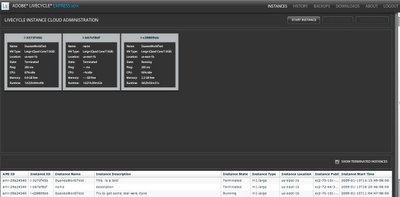
Once you get an instance up and running, it appears to be virtually running on localhost:8080. There is a small download called LiveCycle Developer Express (shown below), which then allows you to log in to the instance running in the cloud.
 Once you log in, select the instance:
 and hit "Connect". Once you connect, you will be able to log in by accessing the admin panel via a browser. The URL is http://localhost:8080/adminui/secured/admin.faces. Note below that I am now logged in as Admin while running it in the cloud from my Mac. What does this mean? LC ES on the Mac!!!
From here you can browse all running services on the instance:
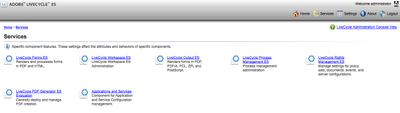
or manage endpoints:
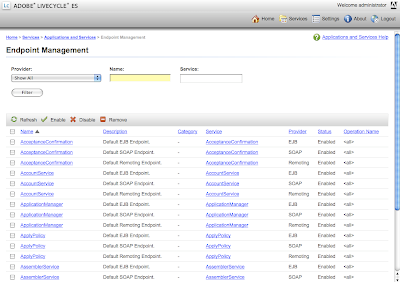
The service, available to all members of the Adobe Enterprise Developer Program, allows developers to bullet-proof their applications without having to invest in a development environment or test lab. I will be unveiling more on a future episode of Duane's World when we get into SOA and ESB cloud architecture.
In case you missed the big news on January 12, Adobe is now offering Adobe LiveCycle ES Developer Express. This is Adobe's first (but not last) major foray into the world of enterprise cloud computing. The LC ES Developer Express software is a full version of Adobe LiveCycle ES that is hosted in the Amazon Web Services cloud computing environment and provides a virtual, self-contained development environment where enterprise developers can prototype, develop, and test LiveCycle applications (*.lca files).
Feature set?
- Provides pre-installed, pre-configured virtual instances of LiveCycle ES.
- Reduce time required to download, install, and boot new server instances.
- Develop LC ES applications in a fraction of the time.
- Virtual instances can be used to build proof-of-concepts
The base installation provides the following LiveCycle ES server applications pre-installed:
- LiveCycle Forms ES
- LiveCycle Reader Extensions ES
- LiveCycle Rights Management ES
- LiveCycle Barcoded Forms ES
- LiveCycle Digital Certificate ES
- LiveCycle Output ES
- LiveCycle Process Management ES
- LiveCycle Content Services ES
- LiveCycle PDF Generator ES

Once you get an instance up and running, it appears to be virtually running on localhost:8080. There is a small download called LiveCycle Developer Express (shown below), which then allows you to log in to the instance running in the cloud.
 Once you log in, select the instance:
 and hit "Connect". Once you connect, you will be able to log in by accessing the admin panel via a browser. The URL is http://localhost:8080/adminui/secured/admin.faces. Note below that I am now logged in as Admin while running it in the cloud from my Mac. What does this mean? LC ES on the Mac!!!
From here you can browse all running services on the instance:

or manage endpoints:

The service, available to all members of the Adobe Enterprise Developer Program, allows developers to bullet-proof their applications without having to invest in a development environment or test lab. I will be unveiling more on a future episode of Duane's World when we get into SOA and ESB cloud architecture.
Wednesday, January 14, 2009
LiveCycle ES Out of Memory Error
Due to repeated posts on this topic on the Google LiveCycle Developers list, I am posting this technical bulletin in its entirety on my blog to help inform people.
Out of Memory errors with LiveCycle ES JBoss turnkey installation
Out of Memory errors with LiveCycle ES JBoss turnkey installation
Issue
Out Of Memory (OOM) errors occur on an Adobe LiveCycle ES Update 1 JBoss turnkey installation. This issue is related to the MySQL JDBC driver version and the data source connection settings.
Caution: This update is strongly recommended.
Reason
Connection checking for the IDP_DS data source has been introduced in LiveCycle ES Update 1. Due to how connection checking is done by MySQL JDBC drivers prior to version 3.22.1 and how JBoss handles the validation result set, heap memory is being used with the JDBC driver, causing multiple open result sets. Because the JDBC driver installed as part of the turnkey installation is version 3.1.12, you must perform the tasks described in this article.
Solution
You must obtain and install version 5.1.6 of the JDBC driver to reduce the number of open result sets and resolve the out of memory issues. You must also change the data source and JVM settings.
Obtaining and installing the JDBC driver
This section describes the tasks required to obtain and install the appropriate MySQL JDBC driver.
To obtain and install the driver:
- Obtain version 5.1.6 of the JDBC driver from the MySQL site by downloading the driver distribution kit mysql-connector-java-5.1.6.zip.
- Unzip the archive file and locate the mysql-connector-java-5.1.6-bin.jar file.
- Locate and delete the mysql-connector-java-3.1.12-bin.jar file in the [JBoss_root]\server\all\lib directory. The default location is C:\Adobe\LiveCycle8.2\jboss\server\all\lib.
- Copy the mysql-connsctor-java-5.1.6-bin.jar file to the [JBoss_root]\server\all\lib directory.
Changing data source settings
The data source settings as defined in the adobe-ds.xml file are intended for a heavy load with many concurrent connections and a long idle connection timeout (10 minutes). This results in a large number of prepared statements being cached on the heap. Reducing the idle connection timeout, the number of maximum open connections, and the size of the prepared statement cache for IDP_DS and EDC_DS will result in a reduction of heap memory allocated to the JDBC connections.
To modify the data source settings:
- Locate and open the adobe-ds.xml file in an editor. By default it is located in C:\Adobe\LiveCycle8.2\jboss\server\all\deploy.
- Locate the line
10
Note: Modify this value for both the IDP_DS and the EDC_DS definitions. - In the IDP_DS definition, locate
- In the EDC_DS definition, locate
Note: If the number of Rights Management requests is high, you may keep the default value for EDC_DS as 20.
- For both IDP_DS and EDC_DS definitions, locate
Note: Setting this value reduces the memory used by the cache and may need to be fine-tuned based on the transaction load on your system.
Changing JVM settings
The JBoss turnkey install sets a number of JVM arguments in the run.bat file and in the JBoss for Adobe LiveCycle ES service definition. After you have updated the JDBC driver, you can modify the run.bat file.
To modify the run.bat file:
- In a text editor, open the run.bat file located in C:\Adobe\LiveCycle8.2\jboss\bin.
- Delete the following arguments:
-XX:NewSize=500
-XX:MaxNewSize=500
-XX:SurvivorRatio=6
If Content Services is not installed, the PermSize value can be reduced to 128 MB.
- Locate the
XX:PermSizesetting and modify the value to128M. - Save and close the file.
To modify the JBoss for Adobe LiveCycle ES service definition you must uninstall and reinstall the service with new JVM arguments specified.
Changing the JBossService settings
The JBoss server is configured using a batch file, InstallJBossService.bat that is created during system installation. During the turn-key setup of LiveCycle, LiveCycle PDF Generator ES support for native document conversion is an optional feature. The batch file will vary slightly, depending on whether you have enabled this feature.
If during the installation you chose to include this feature, then you will have entered a username and password into the LiveCycle setup. You will need to use this username and password to complete the reinstallation of the JBoss service.
To uninstall and reinstall the JBoss for Adobe LiveCycle ES service:
- In a text editor, open the InstallJBossService.bat file located in C:\Adobe\LiveCycle8.2\jboss.
- Delete the following arguments:
-XX:NewSize=500
-XX:MaxNewSize=500
-XX:SurvivorRatio=6
If Content Services is not installed, the PermSize value can be reduced to 128 MB.
- (Optional) Locate the
XX:PermSizesetting and modify the value to128M. - Check if the last part of the .bat file contains
-user %1 -password %2. If so, native document conversion has been configured and you will need to enter the username and password when you reinstall the service.Note: This is not the JBoss service user but the user credentials for the account used to install the native application software (such as Microsoft Office).
- Save and close the file.
Note: You will need the username and password that the service is using. To find the username, open the Services control panel, right-click JBoss for Adobe LiveCycle ES, select Properties from the menu and select the Log On tab. The same username and password combination should be used as during the original install.
- From the Services control panel, stop the JBoss for Adobe LiveCycle ES service.
- Verify that the service is not running in the Service control panel or by entering the following command:
JBossService -status "Jboss for Adobe LiveCycle ES"The resulting message will indicate that the service has been stopped.
- From a command prompt, change to the C:\Adobe\LiveCycle8.2\jboss directory and enter the following command to uninstall the service:
JBossService -uninstall "Jboss for Adobe LiveCycle ES" - Reinstall the service. If native document conversion is enabled you will specify the username and password by entering the following command:
InstallJBossService [domain\username] [password]Where
[domain\username]and[password]are the credentials used during the original installation. If the ID is a local user, then it will be specified using the syntaxMACHINENAME\USERNAME. A domain login ID must be specified asDOMAIN\USERNAME.If native document conversion is enabled you will reinstall the service without specifying a login name using the following command:
InstallJBossService - Verify that the service is running in the Service control panel or by entering the following command:
JBossService -status "Jboss for Adobe LiveCycle ES"
Version Info
LiveCycle ES Update 1 (8.2.1)
TechNote Details
| Last Update: | 11-18-2008 |
| ID: | kb406231 |
| Permanent Link: | http://www.adobe.com/go/kb406231 |
Tuesday, January 13, 2009
Music 2.0 takes huge leap forward!
MixMatchMusic just announced it has acquired Mix2r, a web app that enables electronica artists to upload their music for remixing and for creating derivative works by other electronica artists, fans and music enthusiasts. Mix2r's community of musicians, DJs and fans features more than 6200 songs and music stems. MixMatchMusic also has a ton of online tools for remixing and widgets for remix contests.
"MixMatchMusic's combination with Mix2r adds a lot of dynamic new music to our library and brings us closer to the critical mass of stems and community needed to fuel our next stage of growth," said Charles Feinn, MixMatchMusic co-founder and CEO.
Both the Mix2r and MixMatchMusic sites use or will use Adobe® Flash® Platform technologies including Adobe Flash, Flex and Adobe® AIR™. These technologies will be used to create future versions of the combined site.
Emerging and indie artists win as a result of this combination. The breadth and depth of content and the number of people contributing to it adds energy and creativity to the community, and that in turn will attract more people and more great music.
This is big news for both Mix2r and MixMatchMusic and I look forward to seeing what the combined companies will provide. Congrats to both!
Thursday, January 08, 2009
How to flush Cisco's VPN on a Mac
Cisco's VPN client usually works very well, however sometimes a weird issues pops up. If you get the issue of a 51 error (no subsystem with Internet communications) and in fact have an established connection with an IP address, this workaround will help. Rebooting does not seem to help in these cases.
1. Assuming you have installed the VPN client in the default location, open a shell.
2. You must be su to make this work so type the following:
"sudo /System/Library/StartupItems/CiscoVPN/CiscoVPN restart"
3. This is case sensitive. If it works, you should see the results as shown below.
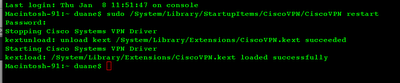 Hopefully, Cisco will figure out why the Mac OS X communications subsystem does not correctly represent its state to the VPN Client.
1. Assuming you have installed the VPN client in the default location, open a shell.
2. You must be su to make this work so type the following:
"sudo /System/Library/StartupItems/CiscoVPN/CiscoVPN restart"
3. This is case sensitive. If it works, you should see the results as shown below.
 Hopefully, Cisco will figure out why the Mac OS X communications subsystem does not correctly represent its state to the VPN Client.
D.O.A. (Doom Oriented Architecture) replaces SOA!
Having now understood Anne Thomas Manes original post (and am in agreement) as well as reading Mark Little's Response as well as formulating my own, I have now come to realize the obvious.
Nothing we do will be remembered in 100 years!
I had a further epiphany:
If anything is in danger of being remembered in 100 years, someone will change the terms to confuse any observer as to it's origins and semantics!
Now why is that relevant to SOA? Well marketeers are really to blame. SOA is sort of funny because most people don't even know where the term came from in the first place. The ebXML Technical Architecture (circa 1999) used the term "services" throughout most of the document but did not actually use the exact term SOA. The United Nations CEFACT Electronic Business Architecture (circa June 2001) was the first to actually use the exact phrase "Service Oriented Architecture" in Section "4.0 Overview" where it explicitly states:
188 Some of the key feature capabilities of this architecture are:
189
190 • Platform independence.
191 • Event driven and Service Oriented Architecture.
...
The W3C Web Services Architecture (which I also worked on) also uses the term Service throughout the document and at roughly the same time as the UN/CEFACT work, added the specific term " 2.3.2 The Service Oriented Model" into the document.
As we all know, ebXML basically has no ISV following yet the principles of its messaging live on in WS-RX, WS-SX, SOAP and other similar protocols/standards under the WS-* umbrella. The thing itself did not die, just morphed into a butterfly.
That is why I am advocating the new term DOA or "Doom Oriented Architecture" since everything we seem to work on is in some way doomed by marketeers changing the buzzwords. Even within companies, terms like "Apollo" get changed to "AIR" which dooms any attempt by evangelists to build a consistent, non-confusing message. In a world of challenges, only doom is real. Doom is also a fun word to say and can be used to build a whole new world of acronyms given there are no good IT words that start with the letter "D".
Perhaps this is only a side effect of the IT industry's master plan to confuse the entire population of the world by constantly changing terms.
DOOM ORIENTED ARCHITECTURE - embrace the future. It's here! It's DOA!
;-)
Nothing we do will be remembered in 100 years!
I had a further epiphany:
If anything is in danger of being remembered in 100 years, someone will change the terms to confuse any observer as to it's origins and semantics!
Now why is that relevant to SOA? Well marketeers are really to blame. SOA is sort of funny because most people don't even know where the term came from in the first place. The ebXML Technical Architecture (circa 1999) used the term "services" throughout most of the document but did not actually use the exact term SOA. The United Nations CEFACT Electronic Business Architecture (circa June 2001) was the first to actually use the exact phrase "Service Oriented Architecture" in Section "4.0 Overview" where it explicitly states:
188 Some of the key feature capabilities of this architecture are:
189
190 • Platform independence.
191 • Event driven and Service Oriented Architecture.
...
The W3C Web Services Architecture (which I also worked on) also uses the term Service throughout the document and at roughly the same time as the UN/CEFACT work, added the specific term " 2.3.2 The Service Oriented Model" into the document.
As we all know, ebXML basically has no ISV following yet the principles of its messaging live on in WS-RX, WS-SX, SOAP and other similar protocols/standards under the WS-* umbrella. The thing itself did not die, just morphed into a butterfly.
That is why I am advocating the new term DOA or "Doom Oriented Architecture" since everything we seem to work on is in some way doomed by marketeers changing the buzzwords. Even within companies, terms like "Apollo" get changed to "AIR" which dooms any attempt by evangelists to build a consistent, non-confusing message. In a world of challenges, only doom is real. Doom is also a fun word to say and can be used to build a whole new world of acronyms given there are no good IT words that start with the letter "D".
Perhaps this is only a side effect of the IT industry's master plan to confuse the entire population of the world by constantly changing terms.
DOOM ORIENTED ARCHITECTURE - embrace the future. It's here! It's DOA!
;-)
Wednesday, January 07, 2009
MAX Japan
I got confirmation I will be presenting at MAX 2009 in Tokyo, Japan. I LOVE Tokyo!!! This is how excited I am:

Courtesy of RedMonk!
I will be doing a sneak peak of using AS3 on the server side. While this was shown in San Fran and Milan, I want to be able to fully explain how it is done and provide some details on the hybrid server-side code works later on this blog.
I hope I get to teach the Flex/AIR Boot Camp in Japan too. That course always fills up and has good results. If you are going to MAX in Tokyo and want that course, please speak up here (leave a comment) so I can forward to the right people.
Courtesy of RedMonk!
I will be doing a sneak peak of using AS3 on the server side. While this was shown in San Fran and Milan, I want to be able to fully explain how it is done and provide some details on the hybrid server-side code works later on this blog.
I hope I get to teach the Flex/AIR Boot Camp in Japan too. That course always fills up and has good results. If you are going to MAX in Tokyo and want that course, please speak up here (leave a comment) so I can forward to the right people.
Mac XML Schema <-> UML tools. Which is best?
I am needing a tool that can slurp in an XML Schema (W3C format but if it does RNG too that would be killer as I prefer it) and show a UML Class View Diagram of the data model. It must run natively on Mac OS X. I would like a tool that recognizes that UML 2.0 can express a superset of an XML model (contain additional constraints), yet be able to convert from the UML to the XML expression of a given data model and preferably generate any warnings of lost constraints/semantics/cardinality rules etc. I do not want to use XMI if I can help it.
Any advice or recommendations would be greatly appreciated. Open source preferred!
Duane
Any advice or recommendations would be greatly appreciated. Open source preferred!
Duane
Tuesday, January 06, 2009
SOA is not dead, but complexity is killing some implementations
I had a number of people send in references and links to various pieces that declare SOA dead. They all seem to be based on an Anne Thomas Manes blog article (which I could not find directly). Before I disagree, I will state I have a lot of respect for Anne as she was one of the few analysts who actually wrote many of the specs discussed in this post and others. Perhaps this is a misunderstanding of semantics? Not sure until I can read it.
Perhaps the semantics problem results from the fact most people still mistakenly think SOA is all about integration. It is not. It is about Architecture, hence the "A" in the acronym. Architecture is not integration, although you can use an architectural description language such as UML to capture the architecture of your integration project. Do you see where I am going with this?
InfoWorld's Paul Krill starts his article with a strange notion:
Now correct me if I am wrong, but SOA is "Service Oriented Architecture". Is Paul implying that architecture that is oriented around services is itself dead, yet the services will exist? This makes no sense as everything has an architecture, whether explicit or not. I also have a lot of respect for Paul Krill and his article was very balanced, exploring some of this.
Services are certainly the mainstay of the new web revolution. Things like SaaS, Mashups and most RIAs depend upon services. I am going to disagree and state that architectures will continue to focus around services as the abstract boundary between needs and capabilities for a long time. In fact, the OASIS SOA Reference Model describes the pattern extremely well and it is durable in that it is not coupled to current technology families like Web Services. SOA is here to last and will last!
Where I can see that there are some aspects dying is the families of technologies that are used to implement SOA have become somewhat passe or too complex. From this standpoint, implementing SOA using the current WS-* stack is a daunting task. This is summed up well in Mark Hansen's "SOA Using Java Web Services". In this book he writes on page 2:
"Am I stupid or are Java Web Services really hard?"
The summary is that, in fact, the WS implementation of SOA fact becoming increasingly complex. Having worked on many of the current standards or just observed their work, things like WS-TX, profiles for Kerberos for WS-Security and the JAXB serialization/deserialization are in fact very advanced technologies and take a lot of forethought. This in turn, will drive many developers to use a REST style SOA approach. Strangely enough, the purported author of SOA's Obituary (Anne), wrote a great blog entry on how NOT to do REST style SOA here.
My conclusion:
SOA is architecture that is focused on services as the abstract action boundary between (business) needs and (business) capabilities. As such, the form of architecture known as SOA that captures that blueprint and relates it to business services is not dead and will survive well into the next decade.
SOA IS NOT DEAD!
Perhaps the semantics problem results from the fact most people still mistakenly think SOA is all about integration. It is not. It is about Architecture, hence the "A" in the acronym. Architecture is not integration, although you can use an architectural description language such as UML to capture the architecture of your integration project. Do you see where I am going with this?
InfoWorld's Paul Krill starts his article with a strange notion:
"SOA is dead but services remain alive, according to a prominent analyst who published an obituary for SOA in a blog post on Monday."
Now correct me if I am wrong, but SOA is "Service Oriented Architecture". Is Paul implying that architecture that is oriented around services is itself dead, yet the services will exist? This makes no sense as everything has an architecture, whether explicit or not. I also have a lot of respect for Paul Krill and his article was very balanced, exploring some of this.
Services are certainly the mainstay of the new web revolution. Things like SaaS, Mashups and most RIAs depend upon services. I am going to disagree and state that architectures will continue to focus around services as the abstract boundary between needs and capabilities for a long time. In fact, the OASIS SOA Reference Model describes the pattern extremely well and it is durable in that it is not coupled to current technology families like Web Services. SOA is here to last and will last!
Where I can see that there are some aspects dying is the families of technologies that are used to implement SOA have become somewhat passe or too complex. From this standpoint, implementing SOA using the current WS-* stack is a daunting task. This is summed up well in Mark Hansen's "SOA Using Java Web Services". In this book he writes on page 2:
"Am I stupid or are Java Web Services really hard?"
The summary is that, in fact, the WS implementation of SOA fact becoming increasingly complex. Having worked on many of the current standards or just observed their work, things like WS-TX, profiles for Kerberos for WS-Security and the JAXB serialization/deserialization are in fact very advanced technologies and take a lot of forethought. This in turn, will drive many developers to use a REST style SOA approach. Strangely enough, the purported author of SOA's Obituary (Anne), wrote a great blog entry on how NOT to do REST style SOA here.
My conclusion:
SOA is architecture that is focused on services as the abstract action boundary between (business) needs and (business) capabilities. As such, the form of architecture known as SOA that captures that blueprint and relates it to business services is not dead and will survive well into the next decade.
SOA IS NOT DEAD!
Friday, January 02, 2009
Happy New Year's!


Trust me - this was a good party! I am off to New York early next week as the grind continues. Flex had a great year in 2008 but this is going to be the year of SOA and BPM as a mainstream "must have". Adobe LiveCycle interest has never been stronger and we are executing on delivering the best ESB for human centric processes.
Predictions:
- more LiveCycle every quarter
- more Flex/AIR/Flash
- Open Screen Project gets in full swing
- more parties like the ones above
Cheers!!
Monday, December 22, 2008
Social Networking is NOT new!!!!
Many people think "social networking" is Web 2.0. They are confused. We are social by nature. What the real Web 2.0 pattern is is the ability to "declare" these social relationships. Groups like Facebook that write an "Architecture of Participation" whereby users can make these declarations. James Governor first picked up on this pattern and called it "Declarative Living". James is right - the only new thing is the declarations.
Here are some more ramblings on web 2.0:
http://www.newzmakerz.com/video/111/Duane-Nickull
Here are some more ramblings on web 2.0:
http://www.newzmakerz.com/video/111/Duane-Nickull
Sunday, December 21, 2008
Christmas, Holidays and me
I don't know why, but this time of year always brings me happiness and optimism. Perhaps it is my children and wife, perhaps the way perfect strangers do random acts of kindness? Today I shoveled a neighbours driveway (2 hours work to remove the snow) but he is 94 years old and it felt like the right things to do. I never asked him for anything but the way he thanked me and in a large city such as Vancouver found it incredible really made my day. Perhaps it is the software industry going for holidays meaning I might get two whole seeks without Adobe, Apple, Microsoft and others trying to update some software on my computer ;-)
This holiday, financial times are tough thanks to a handful of greedy assholes and a system that broke. I want to ask all of you, find forgiveness, find happiness (perhaps some time alone) and find time to do something for someone they would never expect. Bring your neighbours some baking treats, have your colleagues over for a dinner, donate money to the foodbank - whatever. There are people in the world who have not even 1/1000 of what we have. Bif Naked is spending her season getting chemo for a disease she never asked for and there are thousand like her. Yet - she finds time to blog about her experience and shares it publicly. To me, this is a very courageous act of kindness.
Give to LiveStrong. If you cannot afford $$$, just volunteer. Even a smile ( the non "I am stalking you type) makes someones day.
To quote Bif:
"Bliss to you and highest blessings and high fives. Om shanti to you, Om Hare, Om"
It is truly amazing for someone facing a (remote at this time) possibility of death to take the time to wish good things for us. My words?
"Be real, be amazing, be excellent". Do something for someone they can't do four themselves. Don't let pessimists make you believe you cannot make a difference:
Peace, love and metal.
Duane "Chaos" Nickull
Bass ace for hire - any set learned in two days guaranteed. Studio wherever.
This holiday, financial times are tough thanks to a handful of greedy assholes and a system that broke. I want to ask all of you, find forgiveness, find happiness (perhaps some time alone) and find time to do something for someone they would never expect. Bring your neighbours some baking treats, have your colleagues over for a dinner, donate money to the foodbank - whatever. There are people in the world who have not even 1/1000 of what we have. Bif Naked is spending her season getting chemo for a disease she never asked for and there are thousand like her. Yet - she finds time to blog about her experience and shares it publicly. To me, this is a very courageous act of kindness.
Give to LiveStrong. If you cannot afford $$$, just volunteer. Even a smile ( the non "I am stalking you type) makes someones day.
To quote Bif:
"Bliss to you and highest blessings and high fives. Om shanti to you, Om Hare, Om"
It is truly amazing for someone facing a (remote at this time) possibility of death to take the time to wish good things for us. My words?
"Be real, be amazing, be excellent". Do something for someone they can't do four themselves. Don't let pessimists make you believe you cannot make a difference:
Peace, love and metal.
Duane "Chaos" Nickull
Bass ace for hire - any set learned in two days guaranteed. Studio wherever.
Saturday, December 20, 2008
Friday, December 19, 2008
Oil production cut!! Oh no!!!
They cut it to raise the price. Boy did it ever work. What is oil today? Take a look.

That worked well (no pun intended). This just goes to prove there is no logic in our stock/commodity markets anymore.

That worked well (no pun intended). This just goes to prove there is no logic in our stock/commodity markets anymore.
Subscribe to:
Posts (Atom)