Social networks have been around since we have had societies. Everyone has a social network. Even if you have no friends or contacts with anyone else, you still have a social network (in this case of one person - yourself).
So why do people think Web 2.0 is social networking? The epiphany I had is that "declaring" our social networks is what is really new. This is done via a variety of platforms for various types of relationship circles. MySpace, Plaxo, Facebook, LinkedIn, and so on are ideal platforms for these declarations. Each platform has its unique appeal.
What is leading to the end of this phenomena is that people are tired of having to redeclare every relationship every time a new platform comes out. It is long overdue that OpenSocial becomes the lasting monument whereby we can create our declarations once and have them syndicate outwards based on a permissions-based system. So what is stopping this from happening? Simple - a general lack of understanding of binary and n-ary relationships. Here is what I mean.
Here is a declaration: I am friends with Dave Watson.
So what does this really mean? In short, the truth is plain and simple - I have made a unilateral declaration that Dave and I are friends. Why is this potentially errant? Pragmatics and inference errors are abound. We don't know if Dave reciprocates that statement. Is the relationship asymetrical or even traversable? Is it reflexive? Do Dave and I have the exact same definition of "friend"?
You can see how this quickly becomes ambiguous. The solution is to use an upper-level or mid-level ontology to help people understand the nature of these declarations and guide them to correct use. I wrote about this two years ago after a Web 2.0 conference in Berlin here.
James Governor wrote about this pattern of declarative living in a chapter for our upcoming book on Web 2.0. He realized this concept more than two years ago. I guess it took me a while to figure out what he was talking about but the genius of his thinking is still bringing new realizations on a daily basis. Just like I am declaring in this blog article today!
Wednesday, March 18, 2009


Is IBM buying Sun a good move or bad?
There are rumors about IBM perhaps negotiating to buy Sun Microsystems. They are nothing more than rumors at this point yet one cannot help but ponder if this is in fact a good move for IBM. Java, ODF, *nix based operating systems galore are all commonalities. On the other hand, what revenue stream does Sun have? How much redundancy is there? Who will now keep Java from forking?
What do you think?
What do you think?
Tuesday, March 17, 2009
The dangers of Wikipedia
Wikipedia is a collectively authored work purporting itself to be an accurate depiction of our history. What I am seeing more and more is that Wikipedia is a dangerous tool whereby a handful of editors can singlehandedly rewrite major portions of our history. It is often cited as a reference of absolute truth, which compounds this danger.
I have personally encountered several instances of having truth censored by editors. One such case was ebXML. I chaired the Technical Architecture group and also helped write several of the specifications including the Technical Architecture, Registry-Repository, and Core Components specifications. Wikipedia reported as fact that ebXML had only 4 parts when it in fact had 6 parts. When I changed this to reflect what actually happened, some editor (who shall remain nameless) removed my contribution and changed it back to 4. Only through perseverance and pushing the issue was I able to succeed in a compromise. It now reads:
"The original project envisioned five layers of data specification, including XML standards for:
* Business processes,
* Collaboration protocol agreements,
* Core data components,
* Messaging,
* Registries and repositories
All work was completed based on a normative requirements document and the ebXML Technical Architecture Specification."
This is still obviously errant as these are not and were never considered "data" specifications. There were 6 parts to ebXML plus the normative Requirements document. The page is riddled with errors. I cannot change it as my IP has apparently been suspended for "vandalism" (I guess that is what they call "writing the truth" in Wikipedia language). Yes - I could easily use another computer or IP address via VPN to change it but why bother?
The real danger here is that people who lack any reference to ebXML and use this as the single authoritative source for knowledge will leave with the wrong impression. What happens when those people turn out to be university professors, scholars etc? Simple - history is rewritten reflecting non-truth.
Wikipedia is one of the most dangerous institutions in our time. As people such as myself gradually concede and give up trying to make Wikipedia accurate after being whittled down by years of naive editors who think they control their petty fiefdoms, the truth becomes lost and replaced by the editors' version. This reminds me of a quote from Randy Rampage, the front man for a band I play in called "Stress Factor 9":
"you're getting what you pay for when your info is free"
Of course, you cannot look up Stress Factor 9 on Wikipedia as it was deleted. The reason was explained as follows:
23:42, 7 December 2007 Marasmusine (talk | contribs) deleted "Stress Factor 9" (CSD A7: Article does not indicate subject's importance or significance: content was: '{{db-band}} {{Copyedit|date=September 2007}} :''For other uses of the acronym, see DOA''. {{Infobox musical artist | Article does not indicate subject's importance or significance"
When I helped contribute to this page, we noted that the singer for SF9 was Randy Rampage, one of the founding members of DOA. DOA is a legendary punk band that influenced a huge section of modern music including everyone from the Red Hot Chili Peppers to Bif Naked. They are often considered to be the founders of the "Hardcore" sound. Also of note in SF9 was drummer Ray Hartman, the first drummer for the premier metal band Annihilator.
Note that on Randy's personal page, there is a link to Stress Factor 9 including my stage name "Duane Chaos". The link to my band's home page has also been removed as it was deemed insignificant. I wonder how that should be explained to the 100,000 + people who have downloaded our music or come to see us live?
The short end of this stick is that we (society) are having our collective history rewritten by a handful of editors who make decisions about what is important and what is not, what is truth and what is not. Even when confronted with facts, they are often unwilling to accept defeat and allow their own personal views to be recorded as fact.
I am not alone in this criticism of Wikipedia. They are many like me who have had our voices silenced including university professors and many more.
The press and media are watched by watchdog agencies. I think it is time we do the same with Wikipedia.
Monday, March 16, 2009
Epic day skiing!
I've been working like a dog (more like a dog that only works and never plays) so today I took off to grab some fresh powder at Cypress Mountain, only 35 minutes from my Vancouver home near the beach. This was an epic day. Snow was being puked out of the clouds, not bad visibility, and no one on the mountain.
I tried out my new Head Xenon Xi 10.0s. They are simply an amazing ski. In deep powder you can close your eyes and carve, even in semi tracked-out conditions. I found myself jumping quite a bit higher as confidence was way up. This is a shot taken in the air (super fast f-stop).

This shot was on the chair lift. I am smiling although you cannot tell.

Sunday, March 15, 2009
28 AIR applications for AIR Developers
Benjamin has been busy again. If you are an Adobe AIR developer, check out this page.
http://speckyboy.com/2009/03/05/28-adobe-air-apps-for-designers-and-developers-need-some-air/
http://speckyboy.com/2009/03/05/28-adobe-air-apps-for-designers-and-developers-need-some-air/
Monday, March 09, 2009
Computational Intelligence takes huge leap forward
Skynet is here!
Well not quite but there is an important development on the computational intelligence front this week. The launch of the Wolfram Alpha system should be written in history as a key event in the pursuit of computational reasoning. While some pundits in the press think it is just another challenge to Google, the true magnitude of the genius behind this is only the beginning.
Stephen Wolfram is an outstanding mathematician. He has engineered the Mathematica system, which, in the words of Semantics and Ontological guru John Sowa, "is the premier mathematical computing system available."
I have been working with the Ontolog Forum for years and we have argued back and forth whether this type of application is even possible. The consensus seems to be it should be possible but none of us can wait until May 2009 when anybody will be able to ask the Wolfram Alpha a factual question and see the results of that question being answered by formal reasoning or computation from material available on the WWW.
Following is Wolfram's summary of the project:
http://blog.wolfram.com/2009/03/05/wolframalpha-is-coming/
The link below is a testimony by someone who has had hands-on
experience with Wolfram Alpha and seems to believe it has not yet failed:
http://www.twine.com/item/122mz8lz9-4c/wolfram-alpha-is-coming-and-it-could-be-as-important-as-google
This is such a foundationally cool development in the computational intelligence circles and it is creating even some mainstream buzz. What we have discussed and theorized for the last 8 years in the Ontology Forum has apparently come to fruition – a queryable code base using JIT resources classified by FOL and formal set-theory predicate calculus. A machine that emulates a human being able to answer questions by harnessing statements on the web. Imagine!!
This is not the end all for semantic research as there are still lots of un-factual statements on the web, however, what is really impressing me, is that the Wolfram Alpha should apparently be able to resolve conflicts in logic and assess which statements are true and which are not by accessing various resources. While rudimentary and likely comparatively slow (to Google) in process, this is akin to a child just learning to speak and dynamic algorithms could eventually build its knowledge into a true artificially created sentient force capable of reasoning.
Next on my todo list? I want to get on the alpha list!!!
This is, in short, beyond belief and probably an important evolution in our history. Skynet is here!!!
Sunday, March 08, 2009
Why I love my ISP
Shaw High Speed Internet just rocks. Not much else I can say other than see the graphic below. On top of this, a human usually answers the phone within 3 minutes if you ever need service or technical help. In this day and age, that sort of exceptional combination gets my business.


Friday, March 06, 2009
Media not reporting full truth about financial markets
I watched the financial news this week. Every news media outlet reported more or less the same story. The Dow Jones Industrial Average was below 6500 this morning and the subject lines are "Dow Jones industrial average drops below 7,000 for first time since 1997". This is bad but it stops short of telling the whole story.
This comparison uses a linear graph across a temporal variance. The problem is that this excludes inflation. If you inflation adjust the Dow Jones IA, you have to go back quite a few more years. For example, if the Dow was 6,304.87 on December 13, 1996 (as reported by Google Finance), and the inflation rate since 1996 averages around 2.8%, then the inflation adjusted bottom we would have to cross today would be 9,027. Whoops!! What are we at today? 6450 right now?
So what does this mean? Well, I started to do some rough calculations. Without going into all the details, I could not quite find where the inflation adjusted equivalent of today's index was specifically as I did not feel like researching the annual inflation rates to make the calculations, but I did surmise it should be around 1993-5.
The Dow in general though is only accounting for the top 30 stocks on the NYSE. To get a fuller picture, I prefer to use the S&P index. This tells a more thorough story as it is a value weighted index published since 1957 of the prices of 500 large cap common stocks actively traded in the United States.
Take a look at the graph and tell me where you find a year where the S&P index is inflation adjusted to where we are today. The graph is here.
Be vigilant - question everything including this blog post.
Thursday, March 05, 2009
Why I am blocking China and who to blame
Today was the straw that broke the camel's back for me. I have been getting spammed from China for years and years. I have blogged about this before and also pleaded with Chinese officials to crack down on their citizens who spam. I get approximately 100 or more spams a day from China. Most of these get stripped out by our spam filter but at least 20 get through. The one today was from sino5@cnmould.com or "Elva" at Sino Holdings Co., Ltd. www.sinogroupe.com. I have asked these distinguished individuals to stop spamming me before but they just cannot stop. Well, now you can blame them for me now blocking all *.cn traffic from my servers. Yes - you heard me correctly. I have configured many of my email accounts to take all email originating from a *.cn domain and drop it to devnull (meaning it will *never* be seen by a human being).
I hate to have to take this drastic action but spammers like Sino Holdings are to blame. They think it is their right to send out millions of emails to people every day assuming we are interested in their injection molding processes. This costs us money!!! Our economy cannot stand to see another 1-3% of people's productivity wasted every day and mobile costs racked up for emails going to our phones that we don't want.
At the same time I do this, I am going to make one more plea to the Chinese government to treat these people like the criminals they are. If not, others will follow my lead and legitimate businesses in China will suffer as they will not be able to communicate with us. This is not the economic time to risk such barriers to global trade and spammers are hurting us all.
If you are in China and wish to communicate with me by email for legitimate reasons, you cannot do this with a *.cn domain name and will need to find another way. I am also contemplating doing the same with *.ru and *.kr (Russia and Korea) as a way to force legitimate businesses to petition their government to clamp down. These three countries are the "Axis of Spam" due to lax enforcement of regulations. The governments really need to re-think how this will harm their economy as I am sure that spam filters already assign higher probability to emails originating from their countries.
Sorry for doing this but I had to. If you want to retaliate against someone, try Sino Holdings at the URL above. It is their fault. I am sure Elva will be happy to take your complaints.
Wednesday, March 04, 2009
Adobe Cloud Computing now available!
It is official! We're live and open - http://livecycle.express.adobe.com. Adobe LiveCycle ES running on the cloud. How cool is that? Very!
How it works:
LiveCycle ES has both a server component and a desktop workbench. Workbench is configured to talk to the server and the server knows the context of how to talk back to the workbench. In the cloud configuration, a small application called LC DX (Developer Express) sits on the same machine and intercepts all communications to localhost: and translates it to speak to the corresponding LC ES server instance in the cloud. It actually talks to a proxy on the other end so neither the server nor workbench are aware of where the other is. In fact, they both think they are talking to their counterpart at a different location so there is no complexity. Brilliant, simple and clean architecture!
The 1.1 release of Adobe LiveCycle ES Developer Express introduces support for LiveCycle ES 8.2.1 running on Microsoft Windows 2003 Server Enterprise Edition within Amazon EC2, using JBoss 4.2.0 and Microsoft SQL Server 2005 Express. The new Windows-based virtual instances can be selected in the instance type pulldown menu of the "Start Instance" dialog. I blogged earlier about this here:
http://technoracle.blogspot.com/2009/01/adobe-cloud-computing-livecycle-es.html
Here is the screenshot:
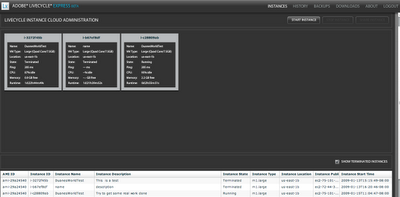
The Windows-based virtual instances of LiveCycle ES are configured with all of the same features as the existing RedHat Linux-based virtual images, including support for BAM, Contentspace, and PDF Generation using OpenOffice. The backup/restore behavior of the Windows-based virtual instances is identical to the behavior of the existing RedHat Linux-based instances.
The 1.1 release also contains a collection of bug fixes and usability improvements.
The LiveCycle Express Networking Application (client) has been updated to include a TCP port forwarding rule for Remote Desktop connections to the new Windows-based virtual instances. With the networking application connected to the instance, Remote Desktop connections can be made to "localhost:3390".
How it works:
LiveCycle ES has both a server component and a desktop workbench. Workbench is configured to talk to the server and the server knows the context of how to talk back to the workbench. In the cloud configuration, a small application called LC DX (Developer Express) sits on the same machine and intercepts all communications to localhost:
The 1.1 release of Adobe LiveCycle ES Developer Express introduces support for LiveCycle ES 8.2.1 running on Microsoft Windows 2003 Server Enterprise Edition within Amazon EC2, using JBoss 4.2.0 and Microsoft SQL Server 2005 Express. The new Windows-based virtual instances can be selected in the instance type pulldown menu of the "Start Instance" dialog. I blogged earlier about this here:
http://technoracle.blogspot.com/2009/01/adobe-cloud-computing-livecycle-es.html
Here is the screenshot:

The Windows-based virtual instances of LiveCycle ES are configured with all of the same features as the existing RedHat Linux-based virtual images, including support for BAM, Contentspace, and PDF Generation using OpenOffice. The backup/restore behavior of the Windows-based virtual instances is identical to the behavior of the existing RedHat Linux-based instances.
The 1.1 release also contains a collection of bug fixes and usability improvements.
The LiveCycle Express Networking Application (client) has been updated to include a TCP port forwarding rule for Remote Desktop connections to the new Windows-based virtual instances. With the networking application connected to the instance, Remote Desktop connections can be made to "localhost:3390".
Tuesday, March 03, 2009
How to work with Adobe
Thanks for reaching out to the Adobe Flash Platform team.
As an evangelist, I spend a lot of time trying to connect people outside the company to the right program inside of Adobe. This is often a win-win scenario. As outsiders, however, it can be daunting to find the right program. This blog post is an attempt to aggregate some of the more important resources for external people to work with at Adobe. I will add more as they become available or people can ping me to add them (just use the comment form to add more).
We want to ensure you have what you need to get started with Adobe! Good luck!
This document outlines the key programs and activities you can leverage from Adobe to be successful with our platform.
Click here to learn more about the Adobe Flash Platform: http://www.adobe.com/flashplatform
PROMOTE YOUR OFFERINGS TO THE COMMUNITY
Customer Success Program: http://www.adobe.com/go/csp
The Adobe Customer Success Program (CSP) works with innovators and business leaders to highlight how organizations use and benefit from Adobe solutions.
Adobe Site of the Day: http://www.adobe.com/go/showcase
Developers can submit applications to be included in the Adobe Site of the Day. This submission allows us to use it in other marketing areas, like the Edge newsletter.
Flex.org: http://flex.org/post_items
Flex.org aggregates Flex news from a number of sources, and allows community members to contribute their own content as well. Learn more: http://flex.org/post_items
The Solution Partner Program: http://www.adobe.com/go/gntray_comm_partners
The Adobe Partner Program is designed for companies that provide solution-based sales, system integration, services, or extended products based on Adobe technology.
Adobe Marketplace: http://www.adobe.com/go/marketplace
Adobe Marketplace is a place where developers can publish their AIR applications for users to download. Learn more: http://www.adobe.com/devnet/air/articles/air_marketplace_faq.html
Community blogs: http://feeds.adobe.com
Add your feed to the Adobe blog aggregator to make sure the community at-large is receiving the latest news on your offerings. Additionally find active community members including Adobe evangelists who may be interested in learning more. Learn more: http://feeds.adobe.com/FAQ.cfm
ACCESS SOFTWARE FOR EVALUATION
Adobe Labs: http://labs.adobe.com/
Labs provides developers with the opportunity to experience and evaluate new and emerging innovations, technologies, and products from Adobe. Learn more: http://labs.adobe.com/about/
Adobe Pre-release Program: http://www.adobe.com/cfusion/mmform/index.cfm?name=prerelease_interest and currently open prerelease opportunities are listed here - http://labs.adobe.com/wiki/index.php/Prerelease
The goal of a Pre-release Program at Adobe is to solicit early feedback on new features and bugs in order to produce a unique and a bug free product that can deliver maximum results.
Also: The Solution Partner Program (http://www.adobe.com/go/gntray_comm_partners)
SUPPORT AND TRAINING
The Adobe Developer Connection: http://www.adobe.com/go/join_adc
The ADC serves as the central resource for information on Adobe developer technologies, providing tutorials, samples, and documentation to guide and instruct developers. Learn more: https://www.adobe.com/devnet/
Adobe Enterprise Developer Program: http://www.adobe.com/devnet/aedp/index.html
Provides developers, architects & forms designers with support, software and tools to build and deploy enterprise solutions built on a SOA, leveraging Adobe technologies.
Adobe Support Programs: http://www.adobe.com/support/programs/
Flex, Flash and AIR support programs for developers and enterprises include technical help and information on planning, workflow and deployment. Learn more: http://www.adobe.com/support/programs/connect_preso/
Adobe Forums: http://www.adobe.com/support/forums/
Adobe Online Forums are for the Adobe community's peer-to-peer discussions of both Adobe and formerly Macromedia products.
Adobe User Groups: http://groups.adobe.com
Adobe Developer User Groups provide a forum of support and technology to web professionals at all levels. Whether you're a designer, a seasoned developer, or are just starting out, Adobe User Groups strengthen community, increase networking, unveil the latest technology innovations, and reveal the techniques that turn novices into experts and experts into gurus.
Adobe Training and Certification: http://www.adobe.com/training/
Whether you want to improve your skills, projects or resume, Adobe training and certification programs and resources can help you achieve your goals.
Flex in a Week Video Training Series: http://www.adobe.com/devnet/flex/videotraining/
A week-long, video based online training program for developers. This self-paced program is free and is intended to help developers accelerate their Flex learning.
Also: Solution Partner Program (http://www.adobe.com/go/gntray_comm_partners), Community Blogs (http://feeds.adobe.com)
PARTNERS
Partner Finder: http://partners.adobe.com/public/asn/partnerfinder/solutionpartner/
Use the Partner Finder to locate an Adobe Solution Partner to help extend the value of your Adobe technology investment and drive your business with tailored solutions.
The Solution Partner Program: http://www.adobe.com/go/gntray_comm_partners
The Adobe Partner Program is designed for companies that provide solution-based sales, system integration, services, or extended products based on Adobe technology.
Monday, March 02, 2009
Learn Flex in One Week!
Learn Flex in a week by going through this video training course! Learned Flex already? Use these materials to go out and teach Flex! Everything is licensed with CREATIVE COMMONS licensing (see bottom of page).
To maximize your learning, Adobe recommends that you view the videos and complete the exercises in the order that they are listed. If you run into problems and have questions, you can ask a question on the Flex in a Week forum or ping me via dnickull at adobe dot com.
Note: Before starting the training, please ensure that you have installed Flex Builder. You can either use the free trial version or buy Flex Builder to go through the training.
You can now download and watch Flex in a Week videos in an offline mode. Here are the instructions.
- Install Adobe Media Player.
- Click "My Favorites" menu at the top.
- Click "Add RSS Feed" at the bottom.
- Paste http://sessions.adobe.com/FlexInAWeek/feed.xml
Day 1: Flex basics
- Video: Comparing Flash, Flex, Flash Player and AIR (5:30)
- Video: Introducing Flex Builder (7:22)
- Video: Creating a Flex Builder workspace and project (7:04)
- Video: Using pre-built Flex controls (4:34)
- Video: Understanding MXML (4:07)
- Exercise: Creating a project and laying out controls (PDF, 832K)
- (Download Solution, ZIP, 14K)
- Video: Binding data between controls (5:48)
- Video: Handling user events (6:22)
- Video: Introducing the event object (10:40)
- Video: Adding EventListeners with ActionScript (5:21)
- Exercise: Binding data and handling a user event (PDF, 367K)
- (Download Starter, ZIP, 14K; Solution, ZIP, 14K)
- Video: Retrieving data via HTTPService (8:26)
- Exercise: Populating a control from an HTTPService request (PDF, 512K)
(Download assets, ZIP, 18K; Starter, ZIP, 14K; Solution, ZIP, 32K)
Day 2: Component development
- Video: Displaying data in the DataGrid (6:35)
- Video: Working with containers (12:12)
- Exercise: Working with containers (PDF, 144K)
- (Download Starter, ZIP, 32K; Solution, ZIP, 32K)
- Video: Creating custom MXML components (8:42)
- Exercise: Creating custom MXML components (PDF, 230K)
- (Download Starter, ZIP, 32K; Solution, ZIP, 33K)
- Video: Implementing value object classes (13:46)
- Video: Creating custom events (5:59)
- Video: Creating custom event classes (23:06)
- Exercise: Creating custom events and dispatching data (PDF, 337K)
- (Download Starter, ZIP, 33K; Solution, ZIP, 34K)
- Video: Customizing item renderers (6:42)
- Exercise: Creating an item renderer (PDF, 128k)
- (Download Starter, ZIP, 34K; Solution, ZIP, 34K)
- Video: Exploring Flex Builder tips (5:18)
Day 3: Putting it all together
- Video: Validating data (7:15)
- Exercise: Validating form data (PDF, 100K)
- (Download Starter, ZIP, 34K; Solution, ZIP, 36K)
- Video: Requesting and sending data with RemoteObject (20:52)
- Exercise: Using RemoteObject to send data to the server (PDF, 503K)
- (Download Server, ZIP 22,642K; Starter, ZIP, 35K; Solution, ZIP, 36K)
- Exercise: ColdFusion version: Using RemoteObject to send data to the server (PDF, 236K)
- (Download Solution, ZIP153K)
- Video: Formatting data (6:09)
- Video: Dragging data between List components (5:20)
- Exercise: Implementing drag and drop between components (PDF, 627K)
- (Download Starter, ZIP, 36K; Solution, ZIP, 36K)
- Video: Filtering XML with E4X (12:04)
- Exercise: Using XML with E4X (PDF, 54K)
- (Download Starter, ZIP, 36K; Solution, ZIP, 37K)
- Video: Deploying Flex and AIR applications (11:57)
- Exercise: Deploying a Flex application (PDF, 504K)
- (Download Starter, ZIP, 37K; Solution, ZIP, 37K)
- Exercise: Creating and deploying an AIR application (PDF, 1,194K)
- (Download Starter, ZIP, 37K; Solution, ZIP, 816K)
Day 4: Adding visual appeal
- Video: Implementing navigator containers (17:15)
- Video: Embedding images (11:58)
- Video: Embedding fonts (28:59)
- Exercise: Working with navigation containers and embedding fonts and images (PDF, 437K)
- (Download Starter, ZIP, 48K; Solution, ZIP, 49K)
- Video: Creating constraint-based layouts (21:50)
- Video: Applying styles to MXML components (29:06)
- Exercise: Working with constraints and using MXML styles (PDF, 277K)
- (Download Starter, ZIP, 49K; Solution, ZIP, 49K)
- Video: Skining components with Adobe CS3 (28:14)
- Exercise: Skinning components graphically (PDF, 1,520K)
- (Download Starter, ZIP, 49K; Solution, ZIP, 81K)
- Video: Creating view states (23:01)
- Video: Animating with behaviors and transitions (18:06)
- Exercise: Working with view states and animation and transitions (PDF, 717K)
- (Download Starter, ZIP, 83K; Solution, ZIP, 84K)
- Video: Drawing shapes with the Drawing API (22:32)
- Video: Skinning components programmatically (12:09)
- Exercise: Drawing shapes and programmatic skinning (PDF, 501K)
- (Download Starter, ZIP, 84K; Solution, ZIP, 85K)
- Video: Extending components (27:27)
- Exercise: Extending components (PDF, 405K)
- (Download Starter, ZIP, 85K; Solution, ZIP, 86K)
Day 5: Architecture and advanced topics
- Video: Understanding the behavior of the Flash timing mechanism (4:18)
- Video: Using custom Flash graphics in Flex components (6:42)
- Video: Using and animating filters (4:35)
- Exercise: Using and Animating Filters (PDF, 62K)
- (Download Starter, ZIP, 86K; Solution, ZIP, 86K)
- Video: Creating SWC files (10:46)
- Exercise: Creating SWC files (PDF, 166K)
- (Download assets, ZIP, 421K Starter, ZIP, 42K; Solution, ZIP, 46K)
- (Download Starter, ZIP, 14K; Solution, ZIP, 14K)
- Video: Building runtime shared libraries (7:15)
- Exercise: Building run time shared libraries (PDF, 207K)
- (Download assets, ZIP, 486K; Starter, ZIP, 43K; Solution, ZIP, 15K)
- Video: Splitting your application into modules (8:45)
- Video: Communicating over local connections (6:20)
- Exercise: Communicating Over Local Connections (PDF, 75K)
- (Download assets, ZIP, 4K; Starter, ZIP, 86K; Solution, ZIP, 86K)
- Video: Using shared objects (4:20)
- Exercise: Using Shared Objects (PDF, 58K)
- (Download Starter, ZIP, 86K; Solution, ZIP, 86K)
- (Download Starter, ZIP, 4K; Solution, ZIP, 4K)
- Video: Reducing the file size of your Flex application (4:58)
- Video: Embedding video in your application (2:09) optional
- Exercise: Embedding Video (PDF, 86K)
- (Download Starter, ZIP, 89K)
- Video: Controlling video using Ajax (2:19) optional
- Video: Localization using resource bundles (5:05)
- Exercise: Localization using Resource Bundles (PDF, 227K)
- (Download Starter, ZIP, 86K; Solution, ZIP, 87K)
- Video: Integrating Flex with PHP using XML (7:44) optional
This work is licensed under a Creative Commons Attribution-Noncommercial 3.0 Unported License.

Friday, February 27, 2009
Duane's World 17 - Tagga.com, ScatterHeart and AIR tutorial
This episode of Duane's World features an interview with Tagga.com founder Amielle Lake. Tagga.com is a very compelling gateway to using mobile for web-based campaigns. Amielle's company has built out a great feature set on tagga.com.
The code and tunes section has a tutorial from James Ward on writing out files to a hard drive in Adobe AIR. The source code is below. Canadian band Scatterheart supplies two great tracks for this episode.
This episode starts in New York and ends with a run down Solar Coaster on Whistler Blackcomb.
The code and tunes section has a tutorial from James Ward on writing out files to a hard drive in Adobe AIR. The source code is below. Canadian band Scatterheart supplies two great tracks for this episode.
This episode starts in New York and ends with a run down Solar Coaster on Whistler Blackcomb.
Wednesday, February 25, 2009
The new Adobe LiveCycle ES secret Decoder ring
For anyone who has found difficulty in keeping up with our marketing department:
http://blogs.adobe.com/livecycledocs/2009/02/the_livecycle_terminology_secr.html
Absolutely brilliant!
http://blogs.adobe.com/livecycledocs/2009/02/the_livecycle_terminology_secr.html
Absolutely brilliant!
Adobe AIR 1.5.1 released, new API
Adobe has now released Adobe AIR 1.5.1, a relatively minor update that includes a number of bug fixes. The new builds are available for Windows, Mac, and Linux on the Adobe AIR download center.
There is also a new API called InvokeEvent.reason. This event is dispatched by the NativeApplication when the application is started from the command line, via the GUI, or by opening an associated file. Applications can register and listen to the InvokeEvent and may also register themselves to launch automatically during user login.
From Robert Christensen:
"You do not need to recompile your application to take advantage of the 1.5.1 improvements. However, if you want to take advantage of the new APIs introduced in this release you will need to update your application descriptor to 1.5.1 (see New APIs section of the release notes) and recompile your application."
Tuesday, February 24, 2009
$100,000 for Flash Lite and Mobile Developers!
One of the greatest industry consortiums ever launched has to be the Open Screen Project. The Open Screen Project is a group of leaders in the mobile, computer and technology industries who are standardizing around Flash for a consistent run time experience. Members include (alphabetically) Adobe, ARM, BBC, Chunghwa Telecom, Cisco, Comcast, Intel , LG Electronics, Marvell, Motorola, MTV Networks, NBC Universal, Nokia, NTT DOCOMO, OpenTV, Palm, Qualcomm, Samsung, Sony Ericsson, Toshiba, Verizon Wireless. These are pretty much the heavyweights and others can easily join. This group has also decided to put their money up to help developers.
First, there is a $10,000,000 USD fund for developers. See http://www.openscreenproject.org/developers/get_started.html?promoid=EJZYZ.
From the site:
First, there is a $10,000,000 USD fund for developers. See http://www.openscreenproject.org/developers/get_started.html?promoid=EJZYZ.
From the site:
The Open Screen Project Fund is a US$10 million market development fund that will provide grants to developers in order to accelerate the creation of applications, content, and services that leverage the Adobe® Flash® Platform and run across mobile, desktop, and consumer electronics devices.
The global initiative was created to fuel innovation by directly commissioning select developers to create innovative applications and by providing education, support, and distribution guidance. Adobe and Nokia are the first contributors to the Open Screen Project Fund."
Concurrently, Adobe has launched the Flash Lite Developer Challenge project for Flash Lite Developers with $100,000 in prizes. This is specifically aimed at mobile development using Flash Lite as the development tool.
On the other side of the technology pond, well known venture capitalist firm Kleiner Perkins has announced a $100 million fund for iPhone developers. The iPhone still does not have Flash capabilities but most of us are hopeful that this will be ironed out so we don't have to boycott the iPhone. Nevertheless, Google and Palm, amongst others, are developing smartphones that will blow away the iPhone so it might not be as relevant in 2 years. Note that Google Android and Flash seem to be a marriage made in heaven. Likewise, the Windows Mobile O/S with Flash is a great combination.
It seems the major heavyweights in the marketplace are vying for the attention of developers. What does all this mean? If you have recently lost your job and are looking for a new career, becoming a mobile developer is probably a very viable strategy in a growth industry. Adobe can help you if you are new to Flash. I have a few free Flex Builder licenses I can give away to people who have recently lost their jobs (sorry - you have to be unemployed to qualify) plus I have a full day of free Flex and Flash training I can provide as a self-paced tutorial so you can get up to speed.
Come join us! This industry is fun. No shortage of money for developers!
Monday, February 23, 2009
The Credit Crunch Explained!
Found this on YouTube. Thought it was a clear distinct explanation. Enjoy.
Friday, February 20, 2009
Need action - Let's get James over 5000 on Twitter!
My buddy James Governor from RedMonk is hovering just under the 5,000 mark on Twitter. He is currently less than 180 shy of cracking the 5K follower mark. Join me and follow James.
http://twitter.com/monkchips
He has a ton of great stuff to say!
http://twitter.com/monkchips
He has a ton of great stuff to say!
Thursday, February 19, 2009
Can technology save the environment?
I have recently purchased a new vehicle with a litres per hundred kilometres active display. This monitors fuel mileage as you drive. What I noticed was both disturbing and a potential place for vast improvement in terms of how technology can help the environment. I hereby give this idea up freely to anyone wishing to pursue it further - this IP is potentially too helpful to have anyone patent it.
I noticed that my vehicle on flat ground cruised along at around 5l/100km (around 55 MPG) through green lights on relatively flat ground. If I had to stop and re-start, the gauge went to 99l/100 km (about 3 MPG) to re-accelerate. After some further testing and calculations, I verified the hypothesis that starting and stopping a vehicle can account for around 80% + of the fuel used vs. flowing traffic. I drove from Whistler to North Vancouver (around 111 km) and used the same amount of gas I used to go the last 15 km through Vancouver.
What does this mean?
Other than validating a few basic laws of physics (conservation of angular momentum, bodies in motion tend to stay in motion, etc.), this means that our governments and almost the entire industry trying to focus on getting better mileage for vehicles is basically inconsequential in comparison to better active/adaptive traffic systems. In fact, other than the move to hybrids (which the jury is still out on in terms of NET energy savings), even if you bettered the mileage of every vehicle by 50%, it would mean a 5% gain compared to a better traffic flow which could deliver potentially up to 50% better return.
While it would not be possible to have green lights for everyone, there are certainly situations I have encountered where a high volume road is sometimes held up for the sake of one or two cars to utilize the right of way of an intersection.
An interim step could be to replace traffic lights that meet certain thresholds with roundabouts to keep traffic from having to completely stop in all directions. Hybrid cars are also good as they rely on capturing brake energy and being able to store it as electricity then use the electricity to re-accelerate the car. IMO - these are good intermediate steps but the holy grail is in a different place.
Opportunity:
What if every vehicle had some form of transponder that could communicate its current MPG to sensors in the road as well as the road being able to sense how many cars are traveling in each direction. A grid of sensors could be used to feed an array of every vehicle on the road into a central planning computer which could optimize the traffic flow (within parameters) for the best fuel efficiency.
I am an environmentalist but I am also a pragmatist. While some advocate that everyone should ride bikes and take public transit, I just don’t see the auto industry silently going away anytime soon. This means an immediate focus on improving hydrocarbon efficiency is probably still warranted IMO.
This is obviously a totally unproven hypothesis however there is sufficient evidence to warrant a test simulation IMO. Even if this proved to be consequential, such a system would take decades to implement.
There are other benefits as well. Now imagine that the transponder could be wired into your electronic dashboard and warn you of events on the road ahead (example - "unexpected hard braking - 100 meters ahead")? You could even have audio communications coming in to the car as instructions to the driver such as "maintain 45 KPH and you will make the next 4 stop lights. If you go faster, you will have to brake and re-accelerate".
This is not some wild pipe dream. All the technology exists today.
Question:
Does this have merit?
Would it be worthwhile conducting some further studies?
Is anyone interested in discussing something like this at FooCamp (or somewhere else) this year (assuming I will be going again)?
Monday, February 16, 2009
LiveCycle Data Services in action - all this week!
If you have not yet seen the future of broadcasting, tomorrow at noon Pacific time, go to http://tracker.amgentourofcalifornia.com/ and create an account to see the live coverage of the Tour of California bike race. Today Levi Leipheimer rode like a madman and took the lead away from a breakaway group. Only Peterson was able to keep pace over the second climb and Peterson snaked by Levi for the stage lead while Levi took the overall GC.
To me, this event is far superior to watch here than on TV. You can choose the cameras (sorry Mr. Producer but mashups and trusting your users are two big patterns on Web 2.0). There is a live chat. The overall GC, text updates, rider tracking, and a host of other interface options allow you, the racing fan, to be in control of what you want to see. The ad revenue model is there too - the sponsor ads stream live just like on TV.
The site is built with LiveCycle Data Services feeding data to a Flex client that registers and gets data pushed out to it as data becomes available. This is the perfect 3-tier architectural use of LiveCycle Data Services. Anyone building a high-traffic RIA nowadays can no longer afford to push all the stuff on the client - you need to have an intermediate tier to aggregate and organize data for an orderly dissemination to clients in a manner consistent with the terms of service and QoS agreements. This will become more important as mobile is fed into the mix.
Rather than repeat it, if you want to know more, hop over to Greg Wilson's blog article on this:
http://gregsramblings.com/2009/02/16/bicycles-flex-and-livecycle-data-services-amgen-tour-of-california/
At Whistler: Where's my high-speed Internet?
At home I have the luxury of SHAW high-speed Internet. It rocks and I get speeds of up to 22,000 KBPS. Let me tell you that I really missed this at Whistler. The hotel I was in had Telus high-speed Internet - vastly overrated and not really high speed. I decided to test it out and see the results. Internet speed tests are nothing new under the sun but it still surprises me how many of them are so unusable - e.g. they need Java installed, they require changing firewall settings, or are just too complicated for such a trivial task. This speed test - www.broadbandspeedchecker.co.uk - originally from the UK uses Flash and can't be easier to use. Just click a button and you will get your result.
Since I do a lot of my business elsewhere, I decided to try the UK-based cloud service. You can give it a try via this widget.
Here are the results from my home office provider. Keep in mind this is a real world test during very busy times.

Some speed tests allow you to choose the server that you want to test the speed against. This leads to inconsistency in results based on your destination. The new Broadband Speed Checker makes it really simple to use and far more consistent by utilizing Amazon CloudFront CDN where you will be tested against the fastest server available to you. Obviously, the online speed tests won't show you everything about your Internet connection - they will show the maximum speed you can achieve at a given time. The average speed you are getting through your broadband cannot be determined by online tools. If you want to monitor your speed and Internet usage on the ongoing basis then I recommend this open source bandwidth meter.
So I leave you with some thoughts on this topic:
1. If you pay for high speed Internet and do not test it, you might be getting ripped off. Use this test.
2. My ISP is Shaw in Western Canada - not only do they give me consistent results that I can verify, they are also one of the few companies left that allows you to speak to a human being after two rings on the telephone.
3. How happy are you with your broadband speed? I'd like to hear some comments about good and bad ISPs. I have had good experience with mine, found Telus a train wreck and Rogers somewhere in the middle in terms of speed but with bad customer service.
Share your experience in the comments.
D
Since I do a lot of my business elsewhere, I decided to try the UK-based cloud service. You can give it a try via this widget.
Provided by Broadband Speed Test
Here are the results from my home office provider. Keep in mind this is a real world test during very busy times.

Some speed tests allow you to choose the server that you want to test the speed against. This leads to inconsistency in results based on your destination. The new Broadband Speed Checker makes it really simple to use and far more consistent by utilizing Amazon CloudFront CDN where you will be tested against the fastest server available to you. Obviously, the online speed tests won't show you everything about your Internet connection - they will show the maximum speed you can achieve at a given time. The average speed you are getting through your broadband cannot be determined by online tools. If you want to monitor your speed and Internet usage on the ongoing basis then I recommend this open source bandwidth meter.
So I leave you with some thoughts on this topic:
1. If you pay for high speed Internet and do not test it, you might be getting ripped off. Use this test.
2. My ISP is Shaw in Western Canada - not only do they give me consistent results that I can verify, they are also one of the few companies left that allows you to speak to a human being after two rings on the telephone.
3. How happy are you with your broadband speed? I'd like to hear some comments about good and bad ISPs. I have had good experience with mine, found Telus a train wreck and Rogers somewhere in the middle in terms of speed but with bad customer service.
Share your experience in the comments.
D
Friday, February 13, 2009
Broadcasting 2.0? The new media
The 2009 Amgen Tour of California, the largest cycling event in America, will stream the race live on the Web using the Adobe Flash Platform. A Tour de France-style cycling event presented by AEG from February 14-22, 2009, the race challenges the world’s top professional cycling teams and the most talented riders— including seven-time Tour de France champion Lance Armstrong (whom I had the honor of meeting)—to compete along a demanding 750-mile course from Sacramento to Escondido, Calif. This marks the third consecutive year that AEG selected the Adobe Flash Platform to bring the race to cycling fans worldwide in streaming video, with real-time rider tracking and live commentary.
The architecture employs a variation of the three tier model - a rich client side, the middle aggregation tier, and the resources which includes live logging of the cyclists positions from GPS. The Tour Tracker was developed using Adobe Flex® Builder™ and Adobe® LiveCycle®, and is meant to be an immersive Web application that incorporates live video, audio, and real-time data streams of the event. So much for regular TV!
When the race starts, you can follow it with the Live Tour Tracker. Cycling fans can track the race minute-by-minute through the innovative and highly interactive online Tour Tracker built on the Adobe Flash Platform. Delivered in the browser with Adobe Flash Player or via a downloadable application powered by Adobe® AIR®, the Tour Tracker ensures not a moment of the race will be missed.
Here are two challenges I want to pose. First - please give to the Lance Armstrong Foundation to fight cancer. This is a nasty disease and has touched so many lives. Lance started this foundation and when he is giving his all on the course, let's give him something back.
Second - I have started a petition to the Tour de France organizers to adopt this technology and broadcast via the web. I want to watch this at work. Please sign this important petition
http://www.thepetitionsite.com/2/tour-de-france-to-broadcast-on-the-web
Wednesday, February 11, 2009
Music 2.0 comes to Twitter
MixMatchMusic (www.mixmatchmusic.com) launched tra.kz, an easy-to-use linking technology that helps musicians virally promote their music and engage fans using Twitter. Controlled Substance Sound Labs label artists including Slightly Stoopid, Pepper, The Expendables, Mat McHugh and The Blackbird, Fishbone, and Rebelution are among some the first bands to promote their music via Twitter campaigns powered by tra.kz.
tra.kz is the first address link and URL shortener specifically for music and music-related content on the micro-web, including MP3s, music videos, artist interviews, news and reviews. Artists, and also fans sending tweets about music, use tra.kz to point to the MP3 files and other music-related content on artist sites, MySpace pages or elsewhere. Without tra.kz, the URL links are often too long to include in tweets and by being given the visual cue of http://tra.kz/, music lovers will know that the link will take them to music related content.
This is a Flash-based solution for artists seeking to make collaborative music and allow people to remix. Twitter provides the updates so if you want to get the latest music in real time, this is the next best thing to being in the actual studio listening to a producer try different mixes of your favorite bands.
What is also cool is that this is linked to a revenue model whereby artists set their parameters and share in revenue from listens, music for movies deals and sales of their content. I also think it is cool because this fights fire with fire. Supply and demand has typically been one artist track being demanded by lots of individuals. Now artists can provide multiple end mixes for one track, this reversing the deprecated economic models of the old music industry.
From MixMatchMusic:
Controlled Substance Sound Labs (http://www.myspace.com/controlledsubstancesoundlabs ) label umbrella for Stoopid Records and Law Records are using tra.kz to engage fans and promote music by releasing new music from artists Pepper, Slightly Stoopid, The Expendables, Fishbone, Rebelution, Mat McHugh and the Blackbird, Sabotage Soundsystem, and Giant Panda Guerilla Dub Squad.
MicMatchMusic CEO Feinn said additional independent artists including BLVD, Angel Pier, Enzyme Dynamite, Trifonic, Throw Me the Statue, Dreamlin featuring Kim Powers, The Dance Party, T. Mandrake, and Radio Nowhere, are also using tra.kz to promote their new releases.
He said that MixMatchMusic will be supporting these artists' Twitter and tra.kz campaigns by releasing a song on Twitter each hour throughout Wednesday, February 11, accompanied by information about the song and artist on Evolving Music (http://evolvingmusic.wordpress.com ).
MixMatchMusic provides emerging artists with a number of technical, social and musical assets with which they can collaborate on, profit from and engage fans with their music:
• A dynamic music community. MixMatchArtists contribute parts of songs, called stems, such as guitar riffs, drum and vocal tracks; works in progress; or finished songs. Community members can search thru this catalog of sounds and songs to find stems to complement their own song ideas and works in progress. They can also communicate with other musicians to discuss song or album projects. Casual fans – even those who don't play an instrument – can experiment with the sounds, discover new music and download stems or songs for use as ringtones or soundtracks for slide shows.
• The MixMaker audio sequencer. Members of the community use the sequencer to mix, match, mash up and manipulate their stems along with stems contributed by various artists. The sequencer combines and synchronizes stems and tracks; its edit tools are powerful and precise, but easy-to-use.
• The MixMatchMusic marketplace. The marketplace is an enlightened system of rights tuned to the unique requirements of digital music and the needs of digital musicians. The marketplace also includes highly transparent accounting processes and transaction logs that ensure musicians know the status of their work, are attributed and paid whenever it is downloaded or used in other art, or even by casual fans as ringtones. Musicians collect 85 cents on each dollar transacted.
• The Remix Wizard is a widget installed on artist sites or MySpace pages that provides fans direct access to a simplified, lightweight version of the sequencer. Artists load stems of their songs into the Remix Wizard and invite their fans to mix and match the various parts and create entirely new compositions from those parts. The Remix Wizard is a simple-to-install and easy-to-use widget that gives indie artists a cool viral tool for engaging fans, and allows them to emulate the hugely popular remix promotions mounted by bands such as Radiohead and Nine Inch Nails.
I am going to set up my bands on this as soon as I am back from Whistler.
Disclaimer: I have a personal financial interest in MixMatchMusic. I just want to disclose that so readers can fairly judge the preceding test.
tra.kz is the first address link and URL shortener specifically for music and music-related content on the micro-web, including MP3s, music videos, artist interviews, news and reviews. Artists, and also fans sending tweets about music, use tra.kz to point to the MP3 files and other music-related content on artist sites, MySpace pages or elsewhere. Without tra.kz, the URL links are often too long to include in tweets and by being given the visual cue of http://tra.kz/, music lovers will know that the link will take them to music related content.
This is a Flash-based solution for artists seeking to make collaborative music and allow people to remix. Twitter provides the updates so if you want to get the latest music in real time, this is the next best thing to being in the actual studio listening to a producer try different mixes of your favorite bands.
What is also cool is that this is linked to a revenue model whereby artists set their parameters and share in revenue from listens, music for movies deals and sales of their content. I also think it is cool because this fights fire with fire. Supply and demand has typically been one artist track being demanded by lots of individuals. Now artists can provide multiple end mixes for one track, this reversing the deprecated economic models of the old music industry.
From MixMatchMusic:
"tra.kz is also a highly viral way for music fans and members of the Twitter community to share music and music-related content among themselves. We think it is going to spark a ton of music discovery, and that's good for artists and fans alike."Fans browsing Twitter feeds will be able to quickly spot out music related content and play music files directly through tra.kz's player. "tra.kz is the no fuss, no muss shortcut for discovering music, and all the great content that surrounds it, directly from a tweet.
Controlled Substance Sound Labs (http://www.myspace.com/
MicMatchMusic CEO Feinn said additional independent artists including BLVD, Angel Pier, Enzyme Dynamite, Trifonic, Throw Me the Statue, Dreamlin featuring Kim Powers, The Dance Party, T. Mandrake, and Radio Nowhere, are also using tra.kz to promote their new releases.
He said that MixMatchMusic will be supporting these artists' Twitter and tra.kz campaigns by releasing a song on Twitter each hour throughout Wednesday, February 11, accompanied by information about the song and artist on Evolving Music (http://evolvingmusic.
MixMatchMusic provides emerging artists with a number of technical, social and musical assets with which they can collaborate on, profit from and engage fans with their music:
• A dynamic music community. MixMatchArtists contribute parts of songs, called stems, such as guitar riffs, drum and vocal tracks; works in progress; or finished songs. Community members can search thru this catalog of sounds and songs to find stems to complement their own song ideas and works in progress. They can also communicate with other musicians to discuss song or album projects. Casual fans – even those who don't play an instrument – can experiment with the sounds, discover new music and download stems or songs for use as ringtones or soundtracks for slide shows.
• The MixMaker audio sequencer. Members of the community use the sequencer to mix, match, mash up and manipulate their stems along with stems contributed by various artists. The sequencer combines and synchronizes stems and tracks; its edit tools are powerful and precise, but easy-to-use.
• The MixMatchMusic marketplace. The marketplace is an enlightened system of rights tuned to the unique requirements of digital music and the needs of digital musicians. The marketplace also includes highly transparent accounting processes and transaction logs that ensure musicians know the status of their work, are attributed and paid whenever it is downloaded or used in other art, or even by casual fans as ringtones. Musicians collect 85 cents on each dollar transacted.
• The Remix Wizard is a widget installed on artist sites or MySpace pages that provides fans direct access to a simplified, lightweight version of the sequencer. Artists load stems of their songs into the Remix Wizard and invite their fans to mix and match the various parts and create entirely new compositions from those parts. The Remix Wizard is a simple-to-install and easy-to-use widget that gives indie artists a cool viral tool for engaging fans, and allows them to emulate the hugely popular remix promotions mounted by bands such as Radiohead and Nine Inch Nails.
I am going to set up my bands on this as soon as I am back from Whistler.
Disclaimer: I have a personal financial interest in MixMatchMusic. I just want to disclose that so readers can fairly judge the preceding test.
Tom's cool Zend AMF PHP extensions!
Normally when I am on vacation, I will post rather work -unrelated posts on this blog. Yesterday's downhill ski run was a good example. Today however, my Adobe compatriot did something so cool I felt compelled to blog about it. Here is the message he sent:
*****************
UPDATE: When I originally posted this, I had credited Tom. It is actually Piotr's creation - Tom was just kind enough to forward this to me. Both these guys are excellent programmers - check out their blogs!
*****************
"Just for your info guys, I published today my ZendAmfDs extension to Zend_Amf... - this is just to let you know if any one is interested in PHP stuff. ZendAmfDs allows you to configure SELECT and INSERT statements on server side (in xml file) and execute these from Flex in a nice and clean way ;) This release doesn’t support UPDATE’s yet but planning to have it implemented or maybe/hopefully someone from the community will pick this up. More info you will find here: http://www.riaspace.net/2009/02/zendamfds-first-release/
Another thing that is very interesting is that I’m receiving very positive feedback after one of my previous blog posts where I described how to configure Zend_Amf with whole Zend Framework and how to use it all together... It turns out people are actually looking into taking whole Zend Framework not only Zend_Amf."
IMO - this is very cool! Go check it out.
*****************
UPDATE: When I originally posted this, I had credited Tom. It is actually Piotr's creation - Tom was just kind enough to forward this to me. Both these guys are excellent programmers - check out their blogs!
*****************
"Just for your info guys, I published today my ZendAmfDs extension to Zend_Amf... - this is just to let you know if any one is interested in PHP stuff. ZendAmfDs allows you to configure SELECT and INSERT statements on server side (in xml file) and execute these from Flex in a nice and clean way ;) This release doesn’t support UPDATE’s yet but planning to have it implemented or maybe/hopefully someone from the community will pick this up. More info you will find here: http://www.riaspace.net/2009/02/zendamfds-first-release/
Another thing that is very interesting is that I’m receiving very positive feedback after one of my previous blog posts where I described how to configure Zend_Amf with whole Zend Framework and how to use it all together... It turns out people are actually looking into taking whole Zend Framework not only Zend_Amf."
IMO - this is very cool! Go check it out.
Tuesday, February 10, 2009
Saturday, February 07, 2009
Are Hotel room numbering conventions depracated?

I found this in the hallway as I was trying to find room 432 (the one I was staying in). I was not really sure what to make of it. I eventually found it and did not have to sleep in a semi-colon.
Whoever made this sign should have given it a bit more thought IMO. Either that or they laugh out loud knowing every day room 432 gets re-assigned to some helpless chap like myself.
Friday, February 06, 2009
I am starting to really, really love ColdFusion (again)
I was an Allaire CF user back in 1999 or thereabouts when it was first available. In fact, I remember Blue Mountain offering it using the "brand new" ASP model. The fact I could integrate data into dynamic HTML was really cool.
If you have been like me, a bit short of CF activity for a long time, it is time to look at CF again. CF rocks!! It is so easy to use and takes minutes to integrate with most technologies. Now I am not a professional programmer who uses it every day, but that is what stands out. Declarative programming languages are just easy to use. CF is the master.
On another note, someone once pointed out that CF developers are paranoid sometimes. I can see why. If you saw your favorite technology being bought and acquired a few times, you might be unsure what direction it may take. I really hope Adobe has been clear but CF developers have a strong evangelist in me and I am an Adobe employee. If I can be of any help to clarify the future of CF or you need an ally, call me. I'll go as far as it takes to ensure CF lives forever!!
I also thought I'd make fun of CF developers (making fun of ourselves used to be part of the CF culture back in the Allaire days) and my boss, Ben Forta, seems to embody this. I wrote an algorithm for how CF developers' internal thinking process works. It is just a joke so please do not take offense.
* yes - I consider myself a CF person now!
*************************************
Import com.array.ColdFusionHaterList.*;
Private var developer = new Developer;
// create a new conversation and pass it the argument of the instance of developer.
Private var myConversation conv = new conversation(developer).startConversation();
// test to see if Coldfusion is mentioned once every twelve words.
if ((conv.getWordCountSpoken() >= 12) && (String(“ColdFusion”) = “false”))
{
coldFusionHaterList.add(developer);
} else {
conv.keepListening();
}
//LOL
I am now offline for the week to go to Whistler and read a CF book to learn more advanced topics. Cheers!
Thursday, February 05, 2009
Adobe AIR covered in Time Magazine
I got an internal email from a colleague today about this article in Time Magazine (note it is on page 2 of the article):
Very cool that Time has recognized the immense value and shift!
"A nice piece in Time Magazine (online today, in hard copy next issue) discusses new applications and products for e-reading, and the future of publishing. The writer references the concept of an “appgazine” — magazines acting “more like computer programs than Web or printed pages.” He interviewed Kevin L who demonstrated the International Herald Tribune Reader and (RED)WIRE applications.
"I saw my first real appgazine one day in downtown San Francisco, at Adobe, a company whose software dominates the production side of the publishing industry. Chief technology officer Kevin Lynch held in his hands a mobile Internet device made by a Chinese company called Aigo. This model, already on the market in Asia, has an easily readable touchscreen. But more interesting than how it looked was the software it was running — Adobe AIR."
Very cool that Time has recognized the immense value and shift!
Subscribe to:
Posts (Atom)