In this RedMonkTV episode, James Governor and I discuss the upcoming O'Reilly book Web 2.0 Design Patterns. If the video below does not work, try this URL:
http://www.ditii.com/2007/10/28/web-20-design-patterns-book/
Wednesday, October 31, 2007


Monday, October 29, 2007
Music 2.0 via Mix2r.fm
Music 2.0 is a new way of making music. Like the early beta in software, where users can participate long before the gold copy comes out, Music 2.0 is about getting people involved in the creation process. Mix2r.com is a platform that gives artists the ability to allow that collaboration and each participant can retain full control over their own licenses of their content.
I am involved in a project on Mix2r.com that requires some input. If you are a musician, please consider this one.
 My alternative band 6th Avenue Nightmare just posted a song called 16 Bottles on Mix2r.fm. The URL to listen or download it for free is here http://www.mix2r.com/node/821.
Here is what we want. If you are a guitarist or play any other instrument that you think might sound good on this, down load this song, then use your recording software like Ableton Live, Pro-tools, Garage Band, Cubase, Adobe Soundbooth etc. and add in a track (or tracks) of your own. When you are finished mixing it up, re-upload it as a derivative work of the original song. You can do this by clicking on the link "derivatives" in the top right hand corner as shown below:

If you are the first, you will see a screen like this:

Click on the link that says "Upload your own derivative of this work". NOTE: you must first have an account to do this. They are free.
Once you have done that, you will be prompted to upload your derivative work along with making some text notes about what you added, your license (for your content only - you cannot override the existing base tracks licenses) and who you are etc.
This song is going on a CD one day and we would also be really happy if anyone submitting tracks could indicate if they are willing to allow their content to be used on the CD.
In addition to this song, there are tons of gigabytes of free music available for both download and remixing. Have fun!!!
I am involved in a project on Mix2r.com that requires some input. If you are a musician, please consider this one.
 My alternative band 6th Avenue Nightmare just posted a song called 16 Bottles on Mix2r.fm. The URL to listen or download it for free is here http://www.mix2r.com/node/821.
 Here is what we want. If you are a guitarist or play any other instrument that you think might sound good on this, down load this song, then use your recording software like Ableton Live, Pro-tools, Garage Band, Cubase, Adobe Soundbooth etc. and add in a track (or tracks) of your own. When you are finished mixing it up, re-upload it as a derivative work of the original song. You can do this by clicking on the link "derivatives" in the top right hand corner as shown below:

If you are the first, you will see a screen like this:

Click on the link that says "Upload your own derivative of this work". NOTE: you must first have an account to do this. They are free.
Once you have done that, you will be prompted to upload your derivative work along with making some text notes about what you added, your license (for your content only - you cannot override the existing base tracks licenses) and who you are etc.
This song is going on a CD one day and we would also be really happy if anyone submitting tracks could indicate if they are willing to allow their content to be used on the CD.
In addition to this song, there are tons of gigabytes of free music available for both download and remixing. Have fun!!!
Thursday, October 25, 2007
New 22nd Century Songs Released on Mix2r.fm
Under my alternate ego, Duane Chaos, I play in several bands (22nd Century and Stress Factor 9 to name just two). One of those, 22nd Century, just released some new mixes on the Music 2.0 social site Mix2r. Mix2r.com allows you to take these songs, download them and add your own tracks to them or remix them.

Regardless, consider taking a listen to the most recent post - the hard rock song "Nightmare on 6th Avenue". I put down bass, lead guitar and vocal tracks on this song. It has a kind of snotty, in your face and get out of my face feel.
http://www.mix2r.com/node/173
Anyone know of any battle of the bands happening at Tech Conferences? I'd love to go and represent Adobe!


Regardless, consider taking a listen to the most recent post - the hard rock song "Nightmare on 6th Avenue". I put down bass, lead guitar and vocal tracks on this song. It has a kind of snotty, in your face and get out of my face feel.
http://www.mix2r.com/node/173
Anyone know of any battle of the bands happening at Tech Conferences? I'd love to go and represent Adobe!
Web 2.0 Design Patterns
The O'Reilly book Web 2.0 Design Patterns cover.

The “Web 2.0” phenomenon has become much more pervasive in 2007 and is impacting the very fabric of society. Web 2.0 presents opportunities to those who understand the core design patterns. These individuals are racing to cash in while Web 2.0 companies like Google see their stock pass $600 a share.
This book focuses on the core design patterns behind Web 2.0. Those core design patterns are supplemented with an abstract model and reference architecture. The result is a set of artifacts that developers, business people, futurists, and entrepreneurs can understand and use.

The “Web 2.0” phenomenon has become much more pervasive in 2007 and is impacting the very fabric of society. Web 2.0 presents opportunities to those who understand the core design patterns. These individuals are racing to cash in while Web 2.0 companies like Google see their stock pass $600 a share.
This book focuses on the core design patterns behind Web 2.0. Those core design patterns are supplemented with an abstract model and reference architecture. The result is a set of artifacts that developers, business people, futurists, and entrepreneurs can understand and use.
Anne Thomas Manes on Web 2.0
I am usually not a big fan of a lot of Web 2.0 statements however today I am sitting in the Burton Catalyst conference in Barcelona and am listening to Anne Thomas Manes describe the core tenets of Web 2.0. Anne is one of the strongest analysts in terms of technical skills and has the unique distinction of actually having written many of the standards and technologies for SOA and web services as opposed to merely studying them. Here is Anne on stage:

Anne has noted, as we wrote in the O'Reilly Web 2.0 Design Patterns book, that a pragmatic analysis of Web 2.0 will help people really understand what is going on. She also noted that things many people think ARE Web 2.0 (such as Rich Internet Applications, SOA, Mashups, and SaaS) are in fact only technologies or specific design patterns. Web 2.0 is an attitude and also a social movement towards the new model whereby users are a core part of the interaction (and architecture to some degree). The client-server model has truly evolved into a new model for Web 2.0 as shown here.
Anne noted that the process of engagement is also core. The old web was a web of searching and browsing whereas Web 2.0 is about participating. Tim O'Reilly's quote is perhaps the best here and by a strange coincidence, both Anne and I used it. Tim stated:
“Don't treat software as an artifact, but as a process of engagement with your users."
Both Anne and fellow Burtonite Chris Haddad also noted that Enterprise 2.0 is really an adoption of the core patterns of Web 2.0 by enterprises. In my opinion, this has accelerated greatly in the last eight weeks as large companies are struggling to adopt the whole Web 2.0 phenomenon.
I am looking forward to more on Web 2.0 from Burton.

Anne has noted, as we wrote in the O'Reilly Web 2.0 Design Patterns book, that a pragmatic analysis of Web 2.0 will help people really understand what is going on. She also noted that things many people think ARE Web 2.0 (such as Rich Internet Applications, SOA, Mashups, and SaaS) are in fact only technologies or specific design patterns. Web 2.0 is an attitude and also a social movement towards the new model whereby users are a core part of the interaction (and architecture to some degree). The client-server model has truly evolved into a new model for Web 2.0 as shown here.
Anne noted that the process of engagement is also core. The old web was a web of searching and browsing whereas Web 2.0 is about participating. Tim O'Reilly's quote is perhaps the best here and by a strange coincidence, both Anne and I used it. Tim stated:
“Don't treat software as an artifact, but as a process of engagement with your users."
Both Anne and fellow Burtonite Chris Haddad also noted that Enterprise 2.0 is really an adoption of the core patterns of Web 2.0 by enterprises. In my opinion, this has accelerated greatly in the last eight weeks as large companies are struggling to adopt the whole Web 2.0 phenomenon.
I am looking forward to more on Web 2.0 from Burton.
Monday, October 22, 2007
Enterprise Mashups, SOA and Web 2.0
For the O'Reilly book Web 2.0 Design Patterns, co-authors James Governor, Dion Hinchcliffe and I have done a lot of research on the relationships between SOA and the core patterns of Web 2.0 such as mashups. Charlton Barreto has written a great post on this topic here and I also recently gave a keynote for the International Conference of Service Oriented Computing on this relationship. The presentation is here - please feel free to poach any slides you want and claim them as your own.
Nevertheless, until the book comes out, the full depth of this relationship has probably not been explored in detail in a publicly available format. Mashups rely on SOA infrastructure. Mashups are a specialized type of client that consume two or more services however there is more to the relationship. Other aspects are the adoption of the core MVC (Model-view-controller) pattern and the ability to allow users to make their own graphical representation available. These are common traits amongst the best mashups.
My friend Stephan Andreasen of Kapow (who also shares an interest in good wines), has probably done some of the greatest work in this realm too.
Nevertheless, until the book comes out, the full depth of this relationship has probably not been explored in detail in a publicly available format. Mashups rely on SOA infrastructure. Mashups are a specialized type of client that consume two or more services however there is more to the relationship. Other aspects are the adoption of the core MVC (Model-view-controller) pattern and the ability to allow users to make their own graphical representation available. These are common traits amongst the best mashups.
My friend Stephan Andreasen of Kapow (who also shares an interest in good wines), has probably done some of the greatest work in this realm too.
Service Component Architecture podcast
Network World recently interviewed me regarding recent developments in the OASIS Service Component Architecture (SCA) and why it is important to enterprise SOAs. The interview was conducted by Network World’s New Data Center Editor Beth Schultz.
Network World
Panorama Podcast: SOA’s ready-made architecture model
iTunes:
http://phobos.apple.com/WebObjects/MZStore.woa/wa/viewPodcast?id=220244986
MP3:
http://podcasts.networkworld.com/panorama/102207pan-soa-adobe.mp3
Network World
Panorama Podcast: SOA’s ready-made architecture model
iTunes:
http://phobos.apple.com/WebObjects/MZStore.woa/wa/viewPodcast?id=220244986
MP3:
http://podcasts.networkworld.com/panorama/102207pan-soa-adobe.mp3
Friday, October 19, 2007
How to install and run Adobe LiveCycle Data Services ES 2.5.1 on Mac OS X
This post outlines step-by-step instructions to get the latest Adobe LiveCycle Data Services ES (formerly Flex Data Services) running natively on a Mac. Okay – before you get excited, Adobe does not support this but I did some tinkering around with JBoss 4.2.1 GA and Adobe LiveCycle Data Services ES 2.5.1 and got it running natively on Mac OS X. Below is the screenshot in Safari.
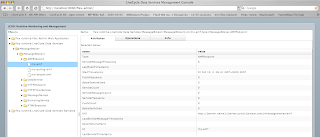
Before you read how to do this, please understand a few things. First, Adobe LiveCycle Data Services ES is not supported on Mac OS X. In fact, we do not even release it (but don’t worry, it is not hard to install). If you do not know what LiveCycle Data Services ES is, it used to be called Flex Data Services. It is now part of the LiveCycle Service platform and has lots of great features. It has a really cool server component that can do wicked messaging stuff to round trip between a J2EE environment and Adobe Flex, AIR, HTML or AJAX applications.
Why? I ported this over and posted this as a result of Adobe MAX 2007 in Barcelona. Macs were everywhere. At JavaOne and MAX, I suspect that about 50-60% of the developers are now using Macs. We used Macs in our hands-on training rooms and they got taken up first.
Here are the full instructions for getting LiveCycle Data Services ES running on a Mac. Please don’t complain if it doesn’t work. We don’t support it (currently -- but if you’re interested tell me and I’ll work on product management to see if we can get it supported) and we’re on our own for now. Here are the steps:
1. Go to JBoss.org and download the JBoss 4.2.1GA release. Unzip it somewhere (I put it on my desktop).
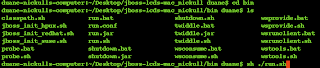
2. Grab a terminal and navigate to the/bin and enter “sh ./run.sh” as shown below. Note – you must run it with sufficient privileges. If you have trouble try entering “sudo sh ./run.sh” and you will be prompted for the SU password.
3. Grab Safari and go to http://localhost:8080 to verify it works. You should see a screen welcoming you to JBoss app server.
4. If it worked, stop the application server by going to the/bin and typing “sh ./shutdown.sh”, then hit enter. Or, you can simply put the cursor in the shell and hit “Control-C”. The latter is not recommended but it works.
5. Go to http://www.adobe.com/products/livecycle/dataservices/ and follow the steps to download LiveCycle Data Services ES version 2.5.1. Make sure you select the AIX version. When you finish downloading it, click the file and install it. (note: it does install even though Adobe does not claim it installs). It will create a directory on the Mac at/Adobe/ as shown below.
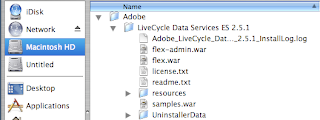
6. Now the important part. Expand the LiveCycle Data Services ES 2.5.1/resources/security/tomcat/ directory then copy the <lcds_install_root>/resources/security/tomcat/flex-tomcat-common.jar and <lcds_install_root>/resources/security/tomcat/flex-tomcat-server.jar into the jboss_root/server/default/lib folder of your JBoss install. This will allow custom authentication to work.
7. From the same location, copy <lcds_install_root>/resources/security/tomcat/context.xml to your JBoss under the WEB-INF directory or adjust an existing context.xml to add the <valve>. You’ll have to open the context.xml files to compare them. Copying works best if you have a fresh install of JBoss.
8. Expand your <lcds_install_directory> and copy the following files:
flex-admin.war flex.war samples.war
9. Paste those samples in the <jboss_install_directory>/server/default/deploy directory.
10. Restart JBoss as described above (Step 2). Get your browser and go to http://localhost:8080/samples and you should see this:
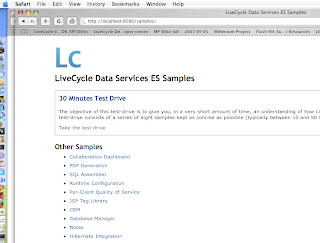
Now try the samples. If they work you have succeeded! Congratulations.
Running it on a Mac, I noticed several advantages. First, the start up time is really fast -- it started in 28 seconds. For contrast, at MAX 2007 in Barcelona, the same software on a PC with 2 GB RAM took about 1:35 to start. I have 4 GB of RAM on an Intel Core 2 Duo machine so it gives it a small advantage.
Enjoy! Let me know if you thought this was cool.

Before you read how to do this, please understand a few things. First, Adobe LiveCycle Data Services ES is not supported on Mac OS X. In fact, we do not even release it (but don’t worry, it is not hard to install). If you do not know what LiveCycle Data Services ES is, it used to be called Flex Data Services. It is now part of the LiveCycle Service platform and has lots of great features. It has a really cool server component that can do wicked messaging stuff to round trip between a J2EE environment and Adobe Flex, AIR, HTML or AJAX applications.
Why? I ported this over and posted this as a result of Adobe MAX 2007 in Barcelona. Macs were everywhere. At JavaOne and MAX, I suspect that about 50-60% of the developers are now using Macs. We used Macs in our hands-on training rooms and they got taken up first.
Here are the full instructions for getting LiveCycle Data Services ES running on a Mac. Please don’t complain if it doesn’t work. We don’t support it (currently -- but if you’re interested tell me and I’ll work on product management to see if we can get it supported) and we’re on our own for now. Here are the steps:
1. Go to JBoss.org and download the JBoss 4.2.1GA release. Unzip it somewhere (I put it on my desktop).
2. Grab a terminal and navigate to the

3. Grab Safari and go to http://localhost:8080 to verify it works. You should see a screen welcoming you to JBoss app server.
4. If it worked, stop the application server by going to the
5. Go to http://www.adobe.com/products/livecycle/dataservices/ and follow the steps to download LiveCycle Data Services ES version 2.5.1. Make sure you select the AIX version. When you finish downloading it, click the file and install it. (note: it does install even though Adobe does not claim it installs). It will create a directory on the Mac at

6. Now the important part. Expand the LiveCycle Data Services ES 2.5.1/resources/security/tomcat/ directory then copy the <lcds_install_root>/resources/security/tomcat/flex-tomcat-common.jar and <lcds_install_root>/resources/security/tomcat/flex-tomcat-server.jar into the jboss_root/server/default/lib folder of your JBoss install. This will allow custom authentication to work.
7. From the same location, copy <lcds_install_root>/resources/security/tomcat/context.xml to your JBoss under the WEB-INF directory or adjust an existing context.xml to add the <valve>. You’ll have to open the context.xml files to compare them. Copying works best if you have a fresh install of JBoss.
8. Expand your <lcds_install_directory> and copy the following files:
flex-admin.war flex.war samples.war
9. Paste those samples in the <jboss_install_directory>/server/default/deploy directory.
10. Restart JBoss as described above (Step 2). Get your browser and go to http://localhost:8080/samples and you should see this:

Now try the samples. If they work you have succeeded! Congratulations.
Running it on a Mac, I noticed several advantages. First, the start up time is really fast -- it started in 28 seconds. For contrast, at MAX 2007 in Barcelona, the same software on a PC with 2 GB RAM took about 1:35 to start. I have 4 GB of RAM on an Intel Core 2 Duo machine so it gives it a small advantage.
Enjoy! Let me know if you thought this was cool.
Adobe MAX 2008 - help us!
Adobe MAX 2008 has been officially announced. It will take place at the Moscone Center in San Francisco, CA. While looking around for comments on this I found someone on Ben Forta's blog post on the subject who objected to the location due to the expense. Sometimes in an attempt to just make things happen, we let details like this slip through the cracks.
I would like to invite anyone who has ideas for how we can make MAX 2008 better to comment on this blog post and give us ideas. One of our corporate mantras is "good ideas come from everywhere in the company" and it seems like now is a good time to go with a truncated Web 2.0 version of that - good ideas come from everywhere.
I would like to invite anyone who has ideas for how we can make MAX 2008 better to comment on this blog post and give us ideas. One of our corporate mantras is "good ideas come from everywhere in the company" and it seems like now is a good time to go with a truncated Web 2.0 version of that - good ideas come from everywhere.
Wednesday, October 03, 2007
Flex Builder on Linux!
To all Linux users:
Sorry man. It took us a while but we get it. We have announced Flex Builder on Linux. It took a while but it is here.
Unlike Mac and Windows though, Flex Builder Linux is a plugin-only version of the Flex Builder.
Call to action:
The Flex Builder for Linux is going out *way* earlier than we would normally release a product in its maturity cycle. The early release is done to provide you the opportunity to provide us with your feedback and let us know your priorities for additional features.
Flex Builder for Linux Download:
http://labs.adobe.com/technologies/flex/flexbuilder_linux/
Sorry man. It took us a while but we get it. We have announced Flex Builder on Linux. It took a while but it is here.
Unlike Mac and Windows though, Flex Builder Linux is a plugin-only version of the Flex Builder.
Call to action:
The Flex Builder for Linux is going out *way* earlier than we would normally release a product in its maturity cycle. The early release is done to provide you the opportunity to provide us with your feedback and let us know your priorities for additional features.
Flex Builder for Linux Download:
http://labs.adobe.com/technologies/flex/flexbuilder_linux/
Sunday, September 30, 2007
Adobe Developer Connection launches
On Friday, Adobe launched the Adobe Developer Connection. Take a look at the new ADC and sign up to start using the updated developer site and new developer program. (If you are already in the MAX introNetwork, then all your information will be copied over to the new ADC introNetwork.)
The ADC is a portal for anyone building web, desktop, and mobile applications using Adobe technology. It provides technical articles, samples, code, and a forum for developers to interact with each other.
More details on ADC are here.
After you check it out, let us know what you think at the ADC feedback forum.
The ADC is a portal for anyone building web, desktop, and mobile applications using Adobe technology. It provides technical articles, samples, code, and a forum for developers to interact with each other.
More details on ADC are here.
After you check it out, let us know what you think at the ADC feedback forum.
MAX 2007 Blog - Day 1
Today is the pre-event day at MAX 2007 in Chicago. I chose Bob Bailey's LiveCycle ES course. Bob is one of the brightest trainers we have and should not be missed. The session is well attended and we have approximately a full room (almost one person for every computer)

I have built a small AIR application for anyone interested in checking out who's blogging on MAX. It can be downloaded here. The source code is available to anyone upon request - just email me dnickull (at) adobe-dot-com. NOTE: When you download this, you may have to go to http://labs.adobe.com and get and install the AIR installer. You may also have to rename *.zip to *.air to run the installer (Vista might change it to *.zip).


I have built a small AIR application for anyone interested in checking out who's blogging on MAX. It can be downloaded here. The source code is available to anyone upon request - just email me dnickull (at) adobe-dot-com. NOTE: When you download this, you may have to go to http://labs.adobe.com and get and install the AIR installer. You may also have to rename *.zip to *.air to run the installer (Vista might change it to *.zip).

Thursday, September 27, 2007
Service Component Architecture? I am a HUGE fan!
The OASIS work on Service Component Architecture really fills an important niche in the pragmatic side of SOA. It is probably the most concrete and pragmatic work for companies to use when taking real steps towards SOA nirvana. SCA is composed of a set of specifications that are very closely aligned with and build on the OASIS Reference Model for SOA.
Imagine this scenario. Your CTO/CIO comes back from some conference and blurts out, "We have to do SOA. All the cool companies are doing SOA!" As an architect/developer the question looms: "What does this really mean?. Sure you can use the abstract Reference Model as a basis for an intelligent conversation on SOA but organizations really need something more concrete to take steps in the real world.
SCA is your answer. The work, originally from the Open SOA Alliance, is now under the auspices of OASIS. SCA is a set of related specifications which describe a model for building applications and systems using a SOA. It is based on business functions being provided as a series of services, which are assembled together to create solutions that serve a particular business need. SCA describes how services are based on a set of related business functions on two levels, one abstract of the actual binding. This is highly advantageous in order to preserve the lexicon of service definitions independent of the specific bindings used.
SCA extends and complements prior approaches to implementing services. Extensions include a programming model for building applications and systems based on open standards such as Web services as well as specific programming languages. The models should be highly effective for business stakeholders and technical stakeholder to align and describe services at various levels of abstraction including their purpose, interfaces and capabilities.
It's important to note that SCA is actually expressed as a group of related specifications, ranging in levels of abstraction from mid-level models to concrete bindings to several specific programming languages (Java and C++ were first).
Adobe has recently joined this effort within OASIS. The work is very relevant to our service oriented platform (LiveCycle Enterprise Suite or LC ES) architecture. In fact, many of the core tenets of SCA assembly have been inherent in LiveCycle ES's design for a while. We use many concepts similar to the service descriptions within the registry-repository component of LiveCycle ES. This allows people to use tools like the LiveCycle Designer and Workbench to assemble services into functional processes and aggregate applications.
I am looking forward to participating in this great work done by IBM, BEA, Oracle, Fujitsu, Hitachi, Red Hat, SAP, TIBCO and many others.
Imagine this scenario. Your CTO/CIO comes back from some conference and blurts out, "We have to do SOA. All the cool companies are doing SOA!" As an architect/developer the question looms: "What does this really mean?. Sure you can use the abstract Reference Model as a basis for an intelligent conversation on SOA but organizations really need something more concrete to take steps in the real world.
SCA is your answer. The work, originally from the Open SOA Alliance, is now under the auspices of OASIS. SCA is a set of related specifications which describe a model for building applications and systems using a SOA. It is based on business functions being provided as a series of services, which are assembled together to create solutions that serve a particular business need. SCA describes how services are based on a set of related business functions on two levels, one abstract of the actual binding. This is highly advantageous in order to preserve the lexicon of service definitions independent of the specific bindings used.
SCA extends and complements prior approaches to implementing services. Extensions include a programming model for building applications and systems based on open standards such as Web services as well as specific programming languages. The models should be highly effective for business stakeholders and technical stakeholder to align and describe services at various levels of abstraction including their purpose, interfaces and capabilities.
It's important to note that SCA is actually expressed as a group of related specifications, ranging in levels of abstraction from mid-level models to concrete bindings to several specific programming languages (Java and C++ were first).
Adobe has recently joined this effort within OASIS. The work is very relevant to our service oriented platform (LiveCycle Enterprise Suite or LC ES) architecture. In fact, many of the core tenets of SCA assembly have been inherent in LiveCycle ES's design for a while. We use many concepts similar to the service descriptions within the registry-repository component of LiveCycle ES. This allows people to use tools like the LiveCycle Designer and Workbench to assemble services into functional processes and aggregate applications.
I am looking forward to participating in this great work done by IBM, BEA, Oracle, Fujitsu, Hitachi, Red Hat, SAP, TIBCO and many others.
Wednesday, September 26, 2007
Adobe MAX 2007 is now SOLD OUT!
My colleague Ted Patrick (ATE) was put in charge of MAX this year to get it more in alignment with developers, architects and other technical personalities. Ted is a rabid over-achiever who strikes me as the type of person who has probably never failed at any job. His mandate was to grow the MAX event from around 3,000 attendees by ten percent.
Today he sent an internal email that indicates the seemingly impossible has happened:
We are officially sold out. Ted rules! For those of you lucky enough to have registered in advance, this year's gonna rawk!! OMG!! Really, really rock!
For those who did not get in this year, I've already started a wish list for MAX 2008 here. Next year there are several things people want:
1. An earlier call for papers
2. Hold the conference on the east or west coast. Maybe we should alternate?
3. More external speakers
4. More technical sessions
5. No marketing fluff
Today he sent an internal email that indicates the seemingly impossible has happened:
We shut down registration last night for MAX due to high number of attendees and our ability to deliver the conference.
First time MAX has "SOLD OUT"!
Ted :)
We are officially sold out. Ted rules! For those of you lucky enough to have registered in advance, this year's gonna rawk!! OMG!! Really, really rock!
For those who did not get in this year, I've already started a wish list for MAX 2008 here. Next year there are several things people want:
1. An earlier call for papers
2. Hold the conference on the east or west coast. Maybe we should alternate?
3. More external speakers
4. More technical sessions
5. No marketing fluff
Friday, September 21, 2007
I've waited 31 years for this

The Canadian dollar is now worth more than the US Dollar. While some have stated that this is primarily due to the fiscal irresponsibility of the current US government, it is also partially due to the strength of the Canadian economy. Should true Republicans be up in arms and have reason to change things? Perhaps, but looking back at the last 31 years, it is actually not bad having a weaker currency. Here are my top predictions for the US and Canada in terms of changes over this new status quo.
1. I think the US will benefit from a weaker dollar in the short and medium terms by keeping some blue collar and other manufacturing related jobs at home. If the US dollar weakens further, it could really help aid the US in terms of foreign orders for the manufacturing sector.
2. The Canadian economy will likely suffer as North American companies with the ability to take advantage of short term fluctuations will likely move manufacturing resources into the US. Canada will likely retain some core natural resource related industries, however processing will likely move south. This is not really bad IMO - it is the real time working of a global economy. Canada built up a good manufacturing sector when it had a weak dollar compared to the US. If this reverses, it should benefit both countries.
3. Pulling out of the war in Iraq will be very desirable for the next US administration. Regardless of Democrat or Republican politics, the economy and relative value of the US dollar will likely be a hot topic in the next 24 months. Luxuries like wars will be also on the table in Canada as mounting costs of our troop presence in Afghanistan also weigh into the national budget debates.
4. Bush is done! He has financially been the most irresponsible president in US history IMO. Forget about morals, he has truly taken a great nation and bankrupted it. Energy costs are at an all time high and the average American still does not have guaranteed health care. America is a great country but it needs to have a good leader. There are about 269,000 or so people in the US I think can do a better job of it than the current leader. Someone please step up and do this.
5. Both Canada and the US will need to work together to maintain competitiveness against the emerging financial superpowers. As globalization is upon us, we must put our petty differences aside and look towards the global stage and figure out how we fit in.
6. The software sector will continue to be profitable, however vendors will have to adjust their strategies to account for disparity in currencies. Currently, the Adobe stock has stayed strong if you live and breathe US dollars. If you are a Canadian shareholder (like me) you have lost 60% of your investments in 3 years on currency issues. Luckily, Adobe is very strong and has doubled in terms of base price leaving us ahead of the game. Nevertheless, foreign investment into Silicon Valley startups might dwindle amid concerns of the weakening US dollar.
Thursday, September 20, 2007
SOA Anti-Patterns: Service Composition and Composite Applications!
FACT: Service Composition is not SOA. It is an anti-pattern of SOA. The same goes for Composite Applications.
I feel like I should have titled this post “The Emperor has no clothes: Part 16” as I have seemingly made a career by challenging the status quo. This post may be a bit of a rant but make sure you read it before passing judgment.
The SOA community has once again used poor judgment in terms of coining titles for aspects of SOA, namely Service Composition and Composite Applications. If these are truly built on an SOA infrastructure, most of them are in fact Service Aggregations and Aggregate Applications. Let me explain where the terms come from and what they really mean.
Composition and Aggregation are both types of Binary Relationships. They are also both specializations of the “whole-part” pattern, a pattern in which a whole “thing” has parts. In both cases, the Whole (in this case the so called Composite Applications and Service Compositions) rely and cannot exist without the Part(s) (the services). There are very subtle yet concrete differences between how Composition and Aggregation work though. The main difference is that in aggregation, the parts can exist without the whole. Wikipedia discusses aggregation (http://en.wikipedia.org/wiki/Object_composition#Aggregation):
“Aggregation differs from ordinary composition in that it does not imply ownership. In composition, when the owning object is destroyed, so are the contained objects. In aggregation, this is not necessarily true”
Composition (as defined by UML) is a special type of relationship where the part and the whole are inextricably linked. In short, the Whole IS MADE UP OF one or more Parts. If the Whole does not exist, neither can the Parts and their life cycle is tied directly to the life cycle of the Whole. The UML composition relationship is depicted below.

Aggregation is a different animal. In an aggregate binary relationship, the Parts may exist without the Whole and be used by more than one “thing”. The Whole CANNOT BE MADE UP OF the Parts. The UML aggregation relationship is depicted below.

Aggregation is akin to how services are utilized within an SOA environment. Services are not contained within the service consumer, services are independent entities within an SOA environment and “consumed” by the consumer. Services can therefore exist without the consumer being present, the opposite of a composition binary relationship. In fact, both services and consumers are usually considered first class entities within an SOA environment as commonly depicted amongst the SOA community. The UML relationship can be depicted below. Note this one is abstract of any stereotype such as <> or <> but these could be added. Consider this more of an existentialist binary relationship.

Given one of the core goals of SOA is the ability to “re-purpose” services amongst several consumers, it would be highly illogical (and an “anti-pattern” of SOA) to tie a service’s life cycle to one single consumer and to constrain that service to exist only within the consumer. That is in effect the pattern SOA strives to avoid. Note that once again, I have changed terms slightly. The term “re-purposed” has been used instead of “re-used”. Services that are re-used only by one consumer do not tend to offer huge advantages other than reducing dependencies and creating agility buy cleanly decoupling the consumer from the core functionality offered via the service.
Business Process Management (BPM), Service Aggregation and Aggregate Software Applications are all specialized types of service consumers. In all three cases they consume services but are not made out of services. The services exist without the consumer.
I am not confident that the industry will change but if you think this makes sense, please take a pledge to start at least making this distinction.
I feel like I should have titled this post “The Emperor has no clothes: Part 16” as I have seemingly made a career by challenging the status quo. This post may be a bit of a rant but make sure you read it before passing judgment.
The SOA community has once again used poor judgment in terms of coining titles for aspects of SOA, namely Service Composition and Composite Applications. If these are truly built on an SOA infrastructure, most of them are in fact Service Aggregations and Aggregate Applications. Let me explain where the terms come from and what they really mean.
Composition and Aggregation are both types of Binary Relationships. They are also both specializations of the “whole-part” pattern, a pattern in which a whole “thing” has parts. In both cases, the Whole (in this case the so called Composite Applications and Service Compositions) rely and cannot exist without the Part(s) (the services). There are very subtle yet concrete differences between how Composition and Aggregation work though. The main difference is that in aggregation, the parts can exist without the whole. Wikipedia discusses aggregation (http://en.wikipedia.org/wiki/Object_composition#Aggregation):
“Aggregation differs from ordinary composition in that it does not imply ownership. In composition, when the owning object is destroyed, so are the contained objects. In aggregation, this is not necessarily true”
Composition (as defined by UML) is a special type of relationship where the part and the whole are inextricably linked. In short, the Whole IS MADE UP OF one or more Parts. If the Whole does not exist, neither can the Parts and their life cycle is tied directly to the life cycle of the Whole. The UML composition relationship is depicted below.

Aggregation is a different animal. In an aggregate binary relationship, the Parts may exist without the Whole and be used by more than one “thing”. The Whole CANNOT BE MADE UP OF the Parts. The UML aggregation relationship is depicted below.

Aggregation is akin to how services are utilized within an SOA environment. Services are not contained within the service consumer, services are independent entities within an SOA environment and “consumed” by the consumer. Services can therefore exist without the consumer being present, the opposite of a composition binary relationship. In fact, both services and consumers are usually considered first class entities within an SOA environment as commonly depicted amongst the SOA community. The UML relationship can be depicted below. Note this one is abstract of any stereotype such as <

Given one of the core goals of SOA is the ability to “re-purpose” services amongst several consumers, it would be highly illogical (and an “anti-pattern” of SOA) to tie a service’s life cycle to one single consumer and to constrain that service to exist only within the consumer. That is in effect the pattern SOA strives to avoid. Note that once again, I have changed terms slightly. The term “re-purposed” has been used instead of “re-used”. Services that are re-used only by one consumer do not tend to offer huge advantages other than reducing dependencies and creating agility buy cleanly decoupling the consumer from the core functionality offered via the service.
Business Process Management (BPM), Service Aggregation and Aggregate Software Applications are all specialized types of service consumers. In all three cases they consume services but are not made out of services. The services exist without the consumer.
I am not confident that the industry will change but if you think this makes sense, please take a pledge to start at least making this distinction.
Friday, August 24, 2007
Adobe MAX 2007 is LiveCycle's breakout year.
Anyone who uses Adobe LiveCycle should definitely consider this year's MAX as a primary place to be in 2007. We have worked hard on making almost 4 full days of content available for the enterprise track and have lined up great sessions and speakers. This is ground zero for anyone who considers themselves a LiveCycle developer. Please also check out the discount available via the Google LiveCycle Developers list.
Organizing a track at MAX is hard. I now have 1163 emails in my MAX 2007 folder and already almost 100 in my Adobe MAX 2008 folder. Thanks to Charlton Barreto the Enterprise and Collaboration track is on track.
Yes - we are maxed out. Puns intended....
Organizing a track at MAX is hard. I now have 1163 emails in my MAX 2007 folder and already almost 100 in my Adobe MAX 2008 folder. Thanks to Charlton Barreto the Enterprise and Collaboration track is on track.
Yes - we are maxed out. Puns intended....
Tuesday, August 21, 2007
Convergence - Web 2.0::Television 2.0
Today is an important milestone in the journey to converge digital media streaming through the Internet. Adobe announced it upgraded its Flash Player with support for the H.264 video-encoding standard and improved audio-compression technology. The changes are astounding! Don't believe me, click on the screen below to experience it. You may have to download the new player first.

Code named "Moviestar," the Flash Player upgrade permits the playback of video encoded using the same standard deployed in Blu-ray and HD DVD high-definition video players for increased compression without quality degradation. It is currently available in beta as a free download, and the final version is expected this fall.
What this means:
Full-screen, TV broadcast quality images over the Internet. It really has to be experienced to be believed.
Code named "Moviestar," the Flash Player upgrade permits the playback of video encoded using the same standard deployed in Blu-ray and HD DVD high-definition video players for increased compression without quality degradation. It is currently available in beta as a free download, and the final version is expected this fall.
What this means:
Full-screen, TV broadcast quality images over the Internet. It really has to be experienced to be believed.
Friday, August 17, 2007
Canadian National Cycling Team needs your help!
As a former professional cyclist who raced for Canada at the World Championships and a world cup veteran of 8 years, I found a very troubling email in my inbox today. Chris Colbeck, a good friend, formidable cycling opponent and now coach of our national team sent out a plea for funding. It seems that our own national cycling body has disgracefully cut all funding from the downhill racing discipline while giving more funding to the Cross Country riders. Chris is not one to sit by while the world turns and has created a national organization to help get funding.
Not only is this move by the Canadian Federation a disgusting slap in the face to one of the largest contingents of mountain bike racers and cyclists in general, it seems to contravene the mandate of UCI, the world's governing organization. The UCI constitution clearly states in Article 3:
To me, this implies equality in funding. Factoring in an adjustment for numbers, this still means we should be getting funding for all disciplines at some level, not putting all our money towards one form of the sport.
The Constitution also goes on to state in Article 6:
This implies that the Canadian organization should incorporate the equality, across not only discipline but gender and other considerations.
Downhill Mountain Bike racers have never fared well with respect to funding. At the 1996 World Championships, we were given used national team jerseys to wear, some of which had to be returned. We paid all our own expenses with the exception of Andrew Shandro, being the #1 seed based on being national champion. Our Dual Slalom squad was totally neglected despite having several top 50 finishes in world cup qualifying (myself included).
The news release is pasted below. I want to urge anyone reading this to please do what you can to help Chris help our 2007 national downhill squad and whatever country you come from, please consider helping to make an athletes dream come true. Representing your country at the world championships or Olympics is the highest honor any athlete can have. To have this taken away by a short sighted lack of funding is horrible.
Not only is this move by the Canadian Federation a disgusting slap in the face to one of the largest contingents of mountain bike racers and cyclists in general, it seems to contravene the mandate of UCI, the world's governing organization. The UCI constitution clearly states in Article 3:
"The UCI will carry out its activities in compliance with the principles of: a) equality between all the members and all the athletes, licence-holders and officials, without racial, political, religious, or other discrimination".
To me, this implies equality in funding. Factoring in an adjustment for numbers, this still means we should be getting funding for all disciplines at some level, not putting all our money towards one form of the sport.
The Constitution also goes on to state in Article 6:
"As members, the federations shall comply with the Constitution and Regulations of the UCI, as well as with all decisions taken in accordance therewith. Likewise, they shall have the Constitution, Regulations and decisions of the UCI complied with by all persons concerned.
2. The Regulations of the UCI shall be incorporated in the corresponding regulations of the federations."
This implies that the Canadian organization should incorporate the equality, across not only discipline but gender and other considerations.
Downhill Mountain Bike racers have never fared well with respect to funding. At the 1996 World Championships, we were given used national team jerseys to wear, some of which had to be returned. We paid all our own expenses with the exception of Andrew Shandro, being the #1 seed based on being national champion. Our Dual Slalom squad was totally neglected despite having several top 50 finishes in world cup qualifying (myself included).
The news release is pasted below. I want to urge anyone reading this to please do what you can to help Chris help our 2007 national downhill squad and whatever country you come from, please consider helping to make an athletes dream come true. Representing your country at the world championships or Olympics is the highest honor any athlete can have. To have this taken away by a short sighted lack of funding is horrible.
Media Release August 16, 2007
FOR IMMEDIATE RELEASE
National Downhill Cycling Foundation of Canada “NDCFC”
&
2007 Canadian National DH Cycling Team
www.NDCFCanada.com / www.NDCFCanada.ca
HEADLINE: National DH Cycling Team making history!
NDCFC and the 2007 National DH cycling team is making history this month!
The team is facing the reality of having no funding! Canadian Cycling Association will offer no direct funding to the Downhill Cycling discipline which is directly inline with the levels of funding received by Sport Canada.
With 10 members on the National DH Team and no funding, manager/coach Chris Colbeck and the athletes have come up with a way to help themselves and the future of the sport! All are trying to travel to the biggest event of the year, the 2007 World Mountain Bike Championships in Fort William, Scotland September 8/9.
Chris Colbeck manager/coach of the 2007 National DH cycling team and former member himself is heading up the National Downhill Cycling Foundation of Canada “NDCFC”. “I will not sit back and watch the athletes struggle year after year after year financially! It paralyzes the future growth of the sport” We have organized a major fundraiser in Vancouver, BC to help the athletes.
For more information please visit our web site or contact Chris Colbeck directly.
Contact Name:
Chris Colbeck
NDCFC President/Founder
National DH Cycling Team Manager
Mobile: 604-932-0809
Ccolbeck@telus.net
PO Box 960 Whistler, BC. V0N1B0 Canada
Thursday, August 16, 2007
Has Wikipedia been Hijacked?
I have become concerned over the last few years of the growing tendency for Wikipedia to censor or delete information that they alone determine is irrelevant. I have always been a fan of Wikipedia in general, but I feel that someone needs to stand up and state clearly that the Emperor has no clothes. Wikipedia is a volunteer driven organization with many good editors. However there appears to be vast discrepancies regarding content. Lately, there have been incidents where editors seem to be acting like dictators. I feel compelled to write becaues of the latest series of incidents that has been brought to my attention, all detailed below with references. I encourage you to read these and contribute to this conversation.
On the Ontolog Forum, I recently conversed with and traded email with a scientist by the name of Jon Awbrey. I decided to look up his name on Google to see what other articles he might have available on the subjects of Computational Intelligence and Ontology/Semantics. I found this link:
http://en.wikipedia.org/wiki/User:Jon_Awbrey
For those of you who do not know Jon, he is a respected member of Ontology circles and has been very active in several groups. He has a long history of useful contributions in a remarkably contentious domain of knowledge. Jon has made numerous contributions to Wikipedia including a lot of information about Charles Peirce. I read Wikipedia's Ban Policy which is well worded and written with seemingly good intent. Wikipedia also seems to be fairly transparent (albeit somewhat cryptic) in their rationale for the ban and publishes the conversations. What I really don't understand is how the politics work.
Sadly, this is not the only incident. Last year my friend Sim Simeonov built an entry for "Social Commerce" which was a challenge because an Internet Explorer crash lost his information (who saw that coming?). Sim's thoughts on Social Commerce are fantastic and worthy of reading by anyone attempting to understand Web 2.0. Sadly, the Wikipedia page was deleted. Sim writes:
"Update: Well, despite the fact that to my knowledge at least 5-6 people contributed to the page and the content was starting to look pretty good, we weren’t able to defeat the Wikipedia bots–they auto-deleted the page, probably due to lack of references. Hard to have references to a new concept… It didn’t help that during that period I had to do a lot of travel and so had limited time to contribute. How about this–put some content in comments to this post and then I’ll try again early next year."
It appears that bots were not the only ones to delete his page. Mailer Diablo, a known Wikipedia editor, apparently deleted the Wikipedia Social Commerce page as described here:
14:52, 13 December 2006 Mailer diablo (Talk | contribs) deleted "Social commerce" (Wikipedia:Articles for deletion/Social commerce)
It is interesting to note that the German page for Social Commerce still exists.
I don't know who Mailer Diablo is but other users have had issues with him including a non-profit organization trying to keep the Wikipedia entry for "Camp Mendocino". Mailer Diablo deleted the page and wouldn't even give the courtesy of replying to the email asking for clarification. The contributor also offered to change the article to meet guidelines. The conversation is public here:
*********************REQUEST***********************
Another good friend of mine, Dick Hardt, had to struggle to save his Wikipedia page. One of the concerns was around "notability" however as user Lori P writes to Wikipedia:
"Not sure why "notability" would be a concern. Dick passes your "google test", with over 160,000 references to him.)".
I too have had run-ins with Wikipedia. Matt MacKenzie and I have derived an Architectural Patterns metamodel from the gang of fours work and updated it to speak to business users as well as to add more details for developers. It comes up #1 in Google for the search term "Architectural Patterns Metamodel" as evidence of its popular use. When listed on the Patterns page (one simple line noting it's existence so people needing a template could download and use it), it was quickly deleted by someone from Wikipedia. I complained and suggested they at least read it. The editor who deleted the line item had no clue as to the contents or usefulness of the template to those who architect, design and develop software.
Conclusions?
In all fairness, it is obviously a hard job to try and keep Wikipedia as a source of fact despite the fact there are valid, opposing opinions. Surely someone who doesn't know Dick or care might think he is not worthy but anyone using Perl considers him an icon. Those who live at Camp Mendocino might have trouble reconciling the fact Wikipedia does not think they exist with their reality. This unfortunately happens at the expense of knowledge for the rest of us.
Wikipedia editors do need to be *very* careful. I am very concerned over the apparent trend to censor information based on the decision of a few individuals. I favor a wider approach and a community that can keep itself in check. I am concerned that the people making these decisions do not have the necessary level of intellect to make the judgment calls on the items they are editing too. Who will contradict Sim's theories on Social Commerce?
We all need to be a bit more vigilant and run to the aid of those who need our help to maintain their Wikipedia pages.
Thoughts? Anyone else think Wikipedia is being hijacked?
On the Ontolog Forum, I recently conversed with and traded email with a scientist by the name of Jon Awbrey. I decided to look up his name on Google to see what other articles he might have available on the subjects of Computational Intelligence and Ontology/Semantics. I found this link:
http://en.wikipedia.org/wiki/User:Jon_Awbrey
For those of you who do not know Jon, he is a respected member of Ontology circles and has been very active in several groups. He has a long history of useful contributions in a remarkably contentious domain of knowledge. Jon has made numerous contributions to Wikipedia including a lot of information about Charles Peirce. I read Wikipedia's Ban Policy which is well worded and written with seemingly good intent. Wikipedia also seems to be fairly transparent (albeit somewhat cryptic) in their rationale for the ban and publishes the conversations. What I really don't understand is how the politics work.
Sadly, this is not the only incident. Last year my friend Sim Simeonov built an entry for "Social Commerce" which was a challenge because an Internet Explorer crash lost his information (who saw that coming?). Sim's thoughts on Social Commerce are fantastic and worthy of reading by anyone attempting to understand Web 2.0. Sadly, the Wikipedia page was deleted. Sim writes:
"Update: Well, despite the fact that to my knowledge at least 5-6 people contributed to the page and the content was starting to look pretty good, we weren’t able to defeat the Wikipedia bots–they auto-deleted the page, probably due to lack of references. Hard to have references to a new concept… It didn’t help that during that period I had to do a lot of travel and so had limited time to contribute. How about this–put some content in comments to this post and then I’ll try again early next year."
It appears that bots were not the only ones to delete his page. Mailer Diablo, a known Wikipedia editor, apparently deleted the Wikipedia Social Commerce page as described here:
14:52, 13 December 2006 Mailer diablo (Talk | contribs) deleted "Social commerce" (Wikipedia:Articles for deletion/Social commerce)
It is interesting to note that the German page for Social Commerce still exists.
I don't know who Mailer Diablo is but other users have had issues with him including a non-profit organization trying to keep the Wikipedia entry for "Camp Mendocino". Mailer Diablo deleted the page and wouldn't even give the courtesy of replying to the email asking for clarification. The contributor also offered to change the article to meet guidelines. The conversation is public here:
*********************REQUEST***********************
Please undelete "Camp Mendocino"
Hi!
I didn't get an answer to this, so I will try again.
You can also find this in your archives:
http://en.wikipedia.org/wiki/User_talk:Mailer_diablo/Archive_%CE%B7
http://en.wikipedia.org/wiki/User_talk:Chiefcoolbreeze
Hello,
If possible, I would like to see the article "Camp Mendocino" undeleted.
Excerpt from deletion notice:
22:22, 15 January 2007 Mailer diablo (Talk | contribs) deleted "Camp Mendocino"
(Proposed deletion expiring after 5 days, 9/1/2007)
I'm not sure why it was deleted. Camp Mendocino belongs to a non profit organization, is very traditional, and has existed since the 1930s. If the article requires changes, please let me know.
Thank you in advance.
User:Chiefcoolbreeze
*********************END RQUEST******************Another good friend of mine, Dick Hardt, had to struggle to save his Wikipedia page. One of the concerns was around "notability" however as user Lori P writes to Wikipedia:
"Not sure why "notability" would be a concern. Dick passes your "google test", with over 160,000 references to him.)".
I too have had run-ins with Wikipedia. Matt MacKenzie and I have derived an Architectural Patterns metamodel from the gang of fours work and updated it to speak to business users as well as to add more details for developers. It comes up #1 in Google for the search term "Architectural Patterns Metamodel" as evidence of its popular use. When listed on the Patterns page (one simple line noting it's existence so people needing a template could download and use it), it was quickly deleted by someone from Wikipedia. I complained and suggested they at least read it. The editor who deleted the line item had no clue as to the contents or usefulness of the template to those who architect, design and develop software.
Conclusions?
In all fairness, it is obviously a hard job to try and keep Wikipedia as a source of fact despite the fact there are valid, opposing opinions. Surely someone who doesn't know Dick or care might think he is not worthy but anyone using Perl considers him an icon. Those who live at Camp Mendocino might have trouble reconciling the fact Wikipedia does not think they exist with their reality. This unfortunately happens at the expense of knowledge for the rest of us.
Wikipedia editors do need to be *very* careful. I am very concerned over the apparent trend to censor information based on the decision of a few individuals. I favor a wider approach and a community that can keep itself in check. I am concerned that the people making these decisions do not have the necessary level of intellect to make the judgment calls on the items they are editing too. Who will contradict Sim's theories on Social Commerce?
We all need to be a bit more vigilant and run to the aid of those who need our help to maintain their Wikipedia pages.
Thoughts? Anyone else think Wikipedia is being hijacked?
Subscribe to:
Posts (Atom)